The short version
- You call the lines on your side of the net, and your opponent calls theirs.
- If you are not sure a ball was out, it was in. Doubt always goes to your opponent.
- The server calls the score out loud before every point. It prevents most disputes.
- The warm-up is shared practice, not a chance to hit winners.
- Disagreements are settled calmly between the two players: replay the point or go back to the last score you both agree on.
Almost every match you play as a club or park player has no umpire, no line judges and no referee to call over. The two of you run it. That works surprisingly well, because of a set of conventions most players pick up by accident and nobody ever quite explains.
This is that explanation. It covers the tennis etiquette that matters in local matches: line calls, scoring, the warm-up and the small habits that make someone a pleasure to play.
Line calls in a match without an umpire
The principle is simple. You call the balls on your side of the net. Your opponent calls the balls on theirs. Each of you accepts the other’s calls.
- Call promptly and clearly. Say “out” as the ball lands, loud enough to be heard, or raise a finger. A late call looks like a change of mind.
- If in doubt, it is in. You may only call a ball out if you clearly saw it out. A ball that might have caught the line is good. A ball you did not see is good.
- Any part of the line is in. A ball that touches the outside edge is as good as one in the middle of the court.
- Call against yourself. If your own shot was clearly out and your opponent played on, say so. If you touch the net, or the ball bounces twice before you reach it, own up.
- Correct yourself. If you call a ball out and realise it was in, the point goes to your opponent. Say so at once.
- Do not ask the spectators. People watching from the next court are not officials and had a worse view than you.
If you doubt your opponent’s call, you can ask once, politely: “Are you sure?” If they say yes, that is the end of it. You cannot overrule a call on their side, and they cannot overrule yours.
If you are not sure a ball was out, it was in.
Serving, lets and foot faults
The receiver calls the serve in or out, and either player can call a let when a serve clips the net and lands in. Call it straight away.
Do not serve until the receiver is ready. Equally, the receiver should play to the server’s reasonable pace and not make them wait.
If a ball rolls onto your court from next door during a point, either player may call a let immediately and the point is replayed. Call it when it happens, not after you have lost the point.
Foot faults are awkward without an official. Do not call them on your opponent. If it is persistent and obvious, mention it quietly at a change of ends. And keep an eye on your own feet.
Scoring etiquette: keeping the score honest
The server calls the score before every point, server’s score first, loud enough for the receiver to hear. It feels formal for about one game. Then it becomes automatic, and it catches a mistake while it is one point old and easy to fix.
At each change of ends, say the game score too. If your court has scorecards on the net post, use them.
If you disagree about the score, stay calm and walk back through the points together: “I served wide, you netted the return, then the long rally…” Usually one of you has forgotten a point. If you still cannot agree, go back to the last score you both accept and play from there.
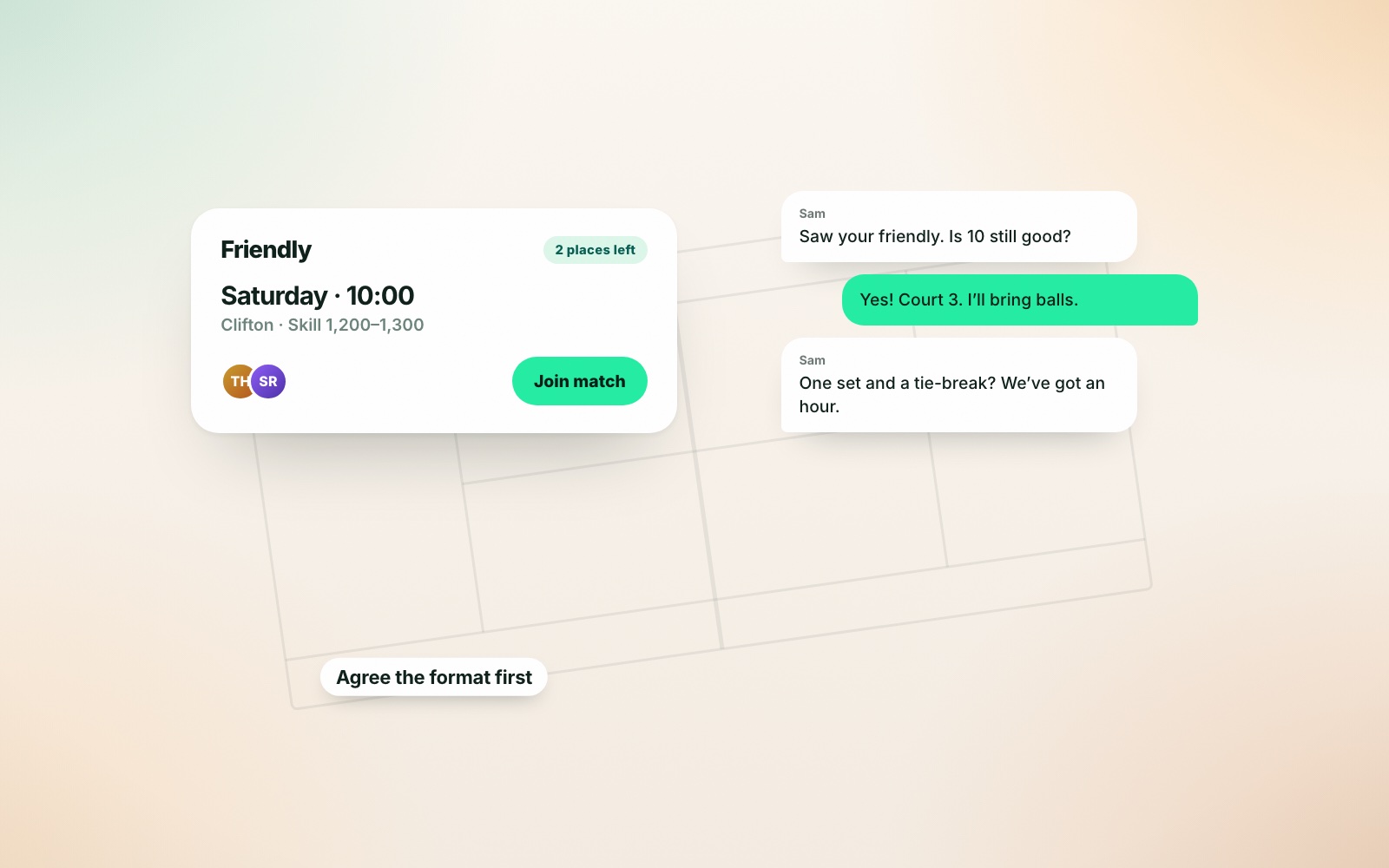
Agree the format before the first point, including what happens at 6–6 and whether a match tie-break replaces a third set. There is a fuller list in how to arrange a friendly.
Warm-up etiquette before a match
The warm-up is about five minutes and it belongs to both of you. Hit the ball to your opponent at a comfortable pace so that you both find a rhythm. It is not the moment for winners down the line.
The usual order is groundstrokes, then each player takes some volleys and a few overheads, then serves. Take your practice serves before the match starts, not before your first service game. When your opponent is serving in the warm-up, catch the balls or block them back gently. Do not practise your returns at full pace.
If you need longer to get loose, arrive early.
Being a good opponent during play
- Be on time, with balls if you said you would bring them.
- Return balls properly. Send them to the server, along the ground or on one bounce, not sprayed into the back fence.
- Wait for points to finish. Do not walk behind another court, or fetch a ball from it, while a point is in play there.
- Keep the noise down. No talking during a point. A phone on silent.
- Acknowledge good shots. “Too good” costs nothing.
- Apologise for a net cord or a mishit winner. A raised hand will do. Everyone knows you are not really sorry.
- Manage your temper. Rackets stay in the hand. Mutter at yourself by all means, never at your opponent.
- Do not coach. Unless asked, keep advice about their backhand to yourself.
- Keep a steady pace. Take the change of ends, have a drink, and get on with it.
Handling a disagreement
Sooner or later you will meet a call you are certain was wrong. You have three sensible options: accept it, ask once whether they are sure, or offer to replay the point if you both truly did not see it. Raising your voice is not among them.
If the calls keep coming, the answer is practical and not confrontational. Play with more margin, finish the match politely, and think twice about arranging another. One bad call rarely decides a match. Stewing over it for three games often does.
If you want to film the match
Ask first, whether you are using ContactFrame or just a phone propped on a bag. Most opponents are happy, and a few are not, which is their right. Set the tripod up before the warm-up, well behind the baseline and out of the playing area, and do not hold up play to adjust it.
After the match
Shake hands at the net and thank your opponent, whatever the score. Collect the balls, take your rubbish and leave the court on time for the next booking.
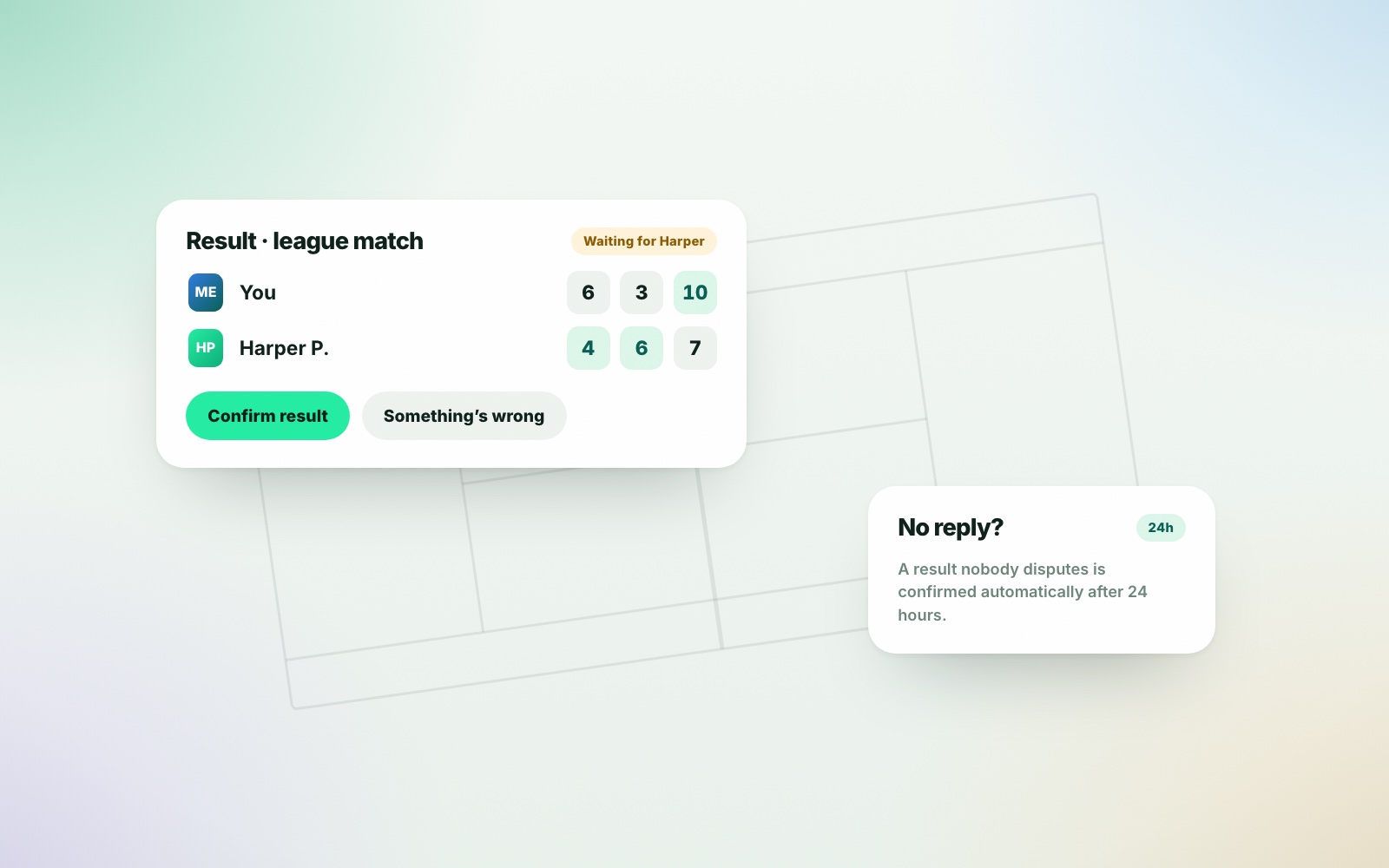
If the match counted, log the result promptly and accurately, or confirm it as soon as your opponent has. On ContactFrame a result nobody disputes is confirmed automatically after 24 hours, but do not make your opponent wait for that. Sitting on a loss is poor form. The process is covered in how to log and confirm tennis match results.
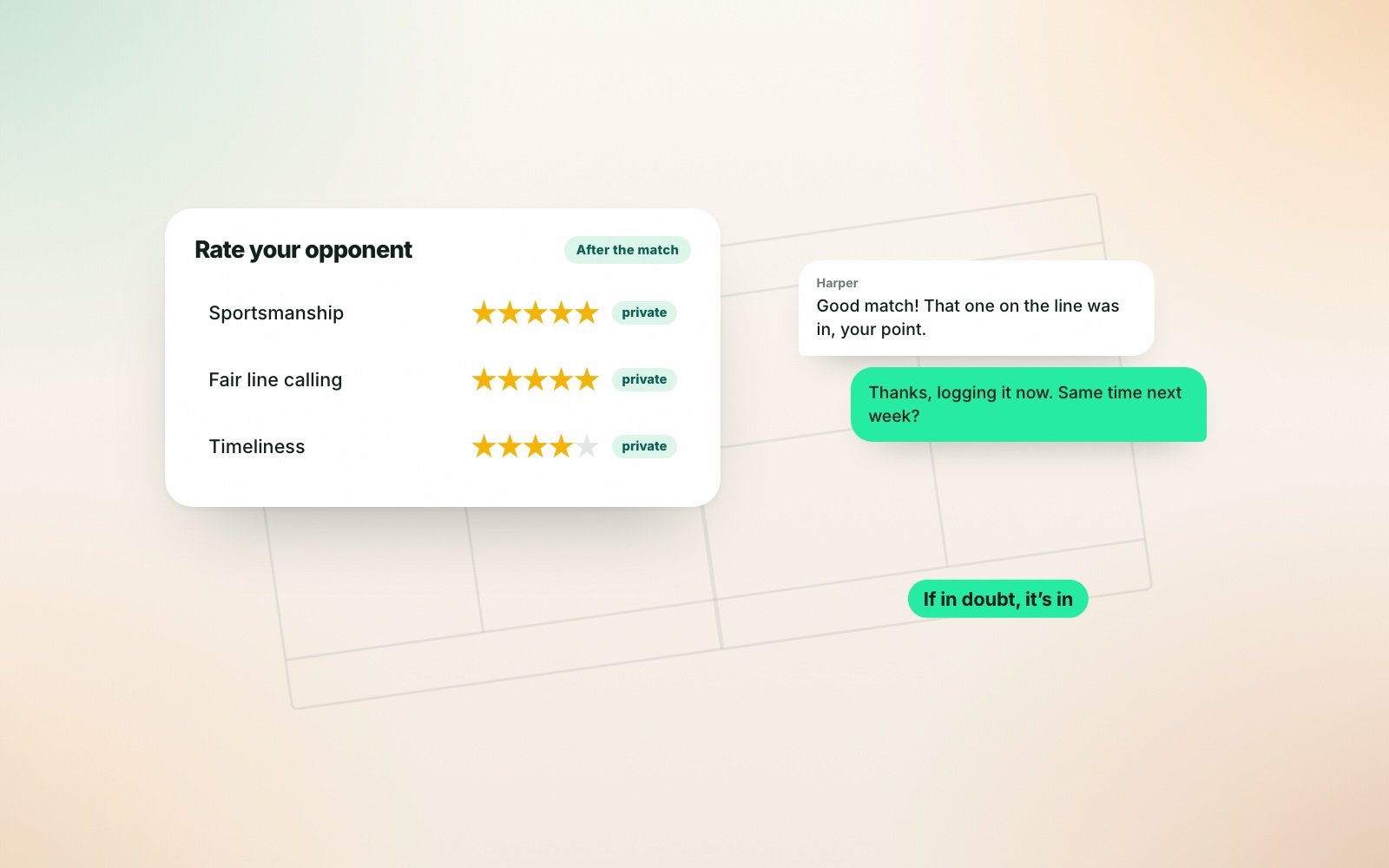
On The Ladder in ContactFrame, you can privately rate an opponent after a match on sportsmanship, fair line calling and timeliness. Those ratings feed the Trust score on each profile. It exists because, in local tennis, your reputation decides who wants to play you again.
That is the real point of etiquette. In a small local scene you will meet the same people for years. Generous calls and a handshake are how you make sure they are pleased to see you. If you are about to play your first match that counts, starting competitive tennis as an adult is a good companion to this piece.
Common questions
Who makes the line calls in a tennis match without an umpire?
Each player calls the balls that land on their own side of the net. You make the call promptly and clearly, and your opponent does the same on their side. You accept their calls as they accept yours.
What should I do if I am not sure whether a ball was in or out?
Play it as in. The accepted convention is that any doubt is resolved in your opponent’s favour, and a ball you cannot call out with certainty is good.
What do we do if we disagree about the score?
Go back through the points together and find the last score you both agree on, then play on from there. If you cannot agree, replaying from a fair midpoint or spinning a racket is better than an argument.
Can I use a video or app replay to settle a line call?
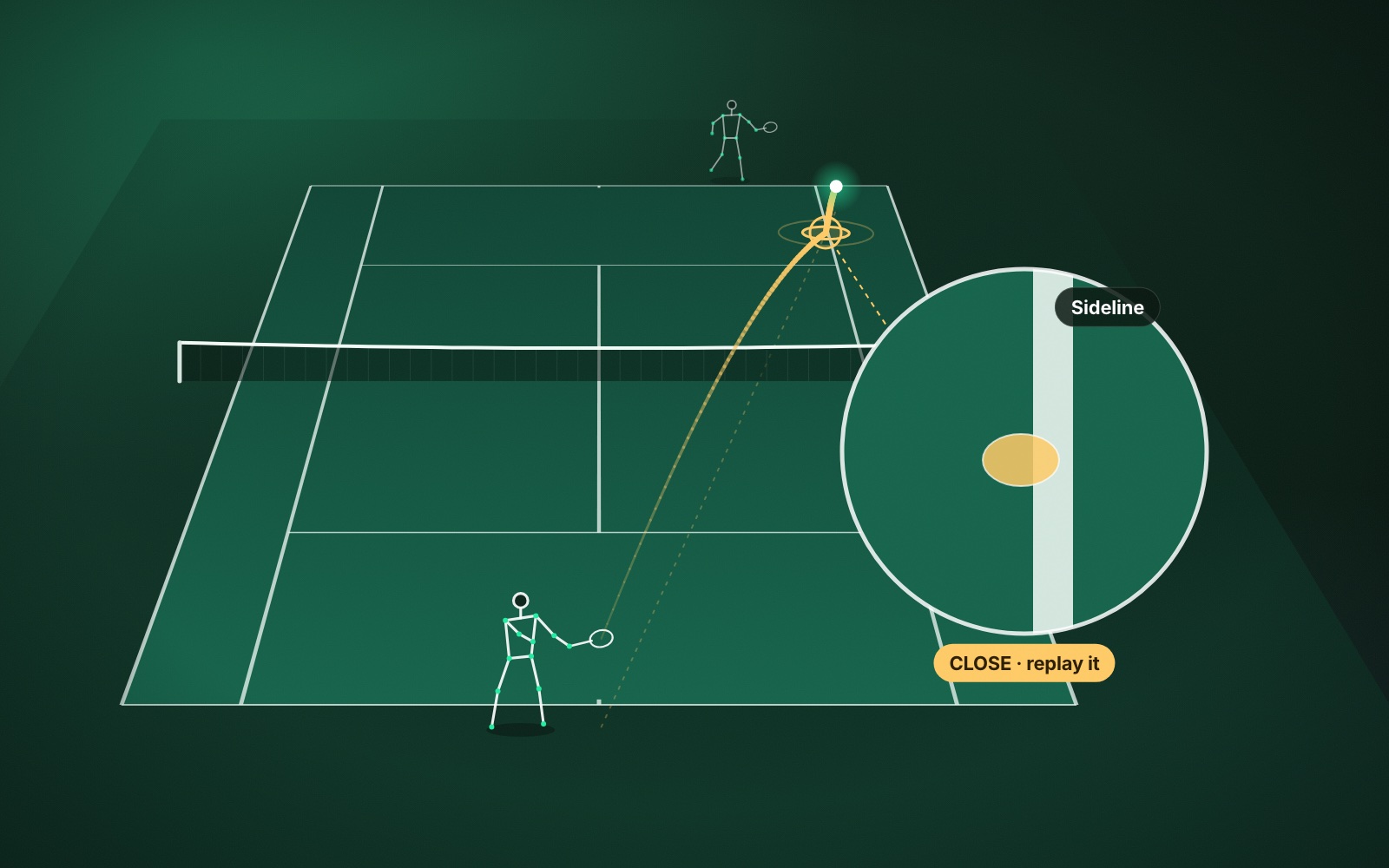
Only if you both agreed to before the match, and even then it is a courtesy and not an official ruling. ContactFrame’s in, out and close calls are for coaching and review, not official line calling. In an unofficiated match the player’s call stands.
How long should the warm-up be before a tennis match?
About five minutes is standard, covering groundstrokes, volleys, overheads and serves. If you want longer, arrive early and agree it with your opponent.
Play fair. Be remembered for it.
Join the list for ContactFrame, where good opponents earn a Trust score to match their Skill.
See The Ladder