The short version
- Babolat told users it stopped selling Play rackets and POP on 1 March 2021 and would keep the app running until 31 December 2021.
- Your Play racket still works as a normal racket. Only the sensor data is gone.
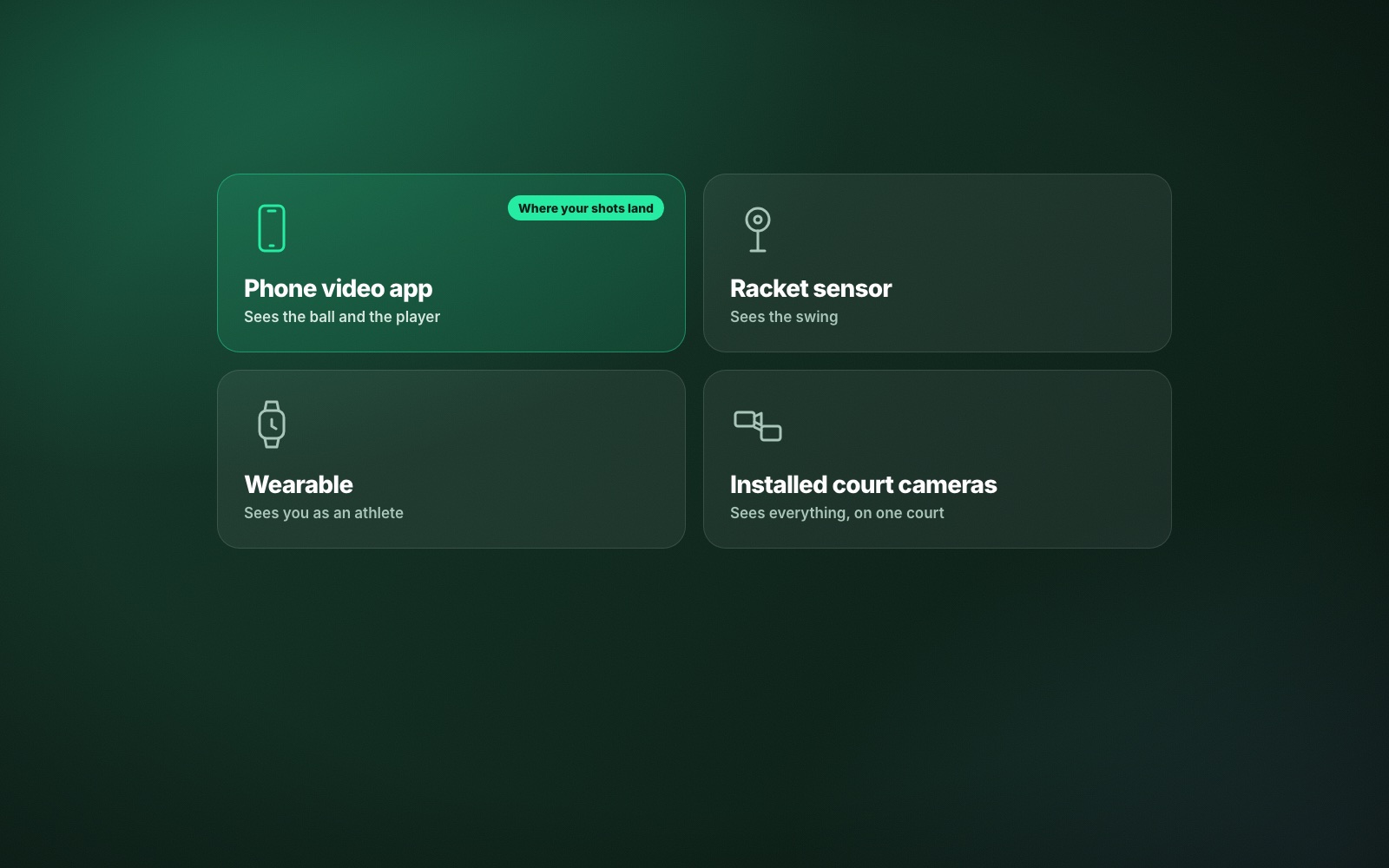
- Babolat’s sensors measured the swing. Phone video measures the ball and the body, including where every shot landed.
- ContactFrame is our pick for most club players: one phone, iOS and Android at launch, GBP pricing. It is not out yet, so join the list.
- SwingVision suits iPhone owners who need something now; watch apps and radars cover scoring and serve speed.
If you own a Babolat Play racket or a POP wristband, you have probably found that the app no longer gives you anything. The racket is fine; the service behind it closed. This guide explains what Babolat told users and the best Babolat Play alternatives for tracking your tennis now.
A quick disclosure: we make ContactFrame, so weigh our pick accordingly. Everything we say about the other products comes from their own websites and app store pages, checked in November 2026. Prices and features change, so check before you buy.
What happened to Babolat Play and POP
Babolat had two connected products. Babolat Play rackets (Pure Drive Play, Pure Aero Play and Pure Strike Play) had a sensor built into the handle. It recorded stroke type, spin, where you hit the string bed, power, rally length and play time. Babolat POP was a wristband, built with the sensor company PIQ, that worked with any racket. It counted shots by type, estimated spin and speed, and tracked rallies and play time. It only worked with your phone nearby, because the band did not store data itself.
Babolat told users, in a customer notice quoted by players on the Tennis Warehouse forum, that it had stopped all sales of its connected devices, the Play racket and POP, as of 1 March 2021. The same notice said the app would be maintained until 31 December 2021. Buyers who purchased after 1 January 2019 were offered compensation; we could not confirm the details.
The practical upshot: a Play racket is now simply a racket, and a good one if you liked it. You just cannot read the sensor any more.
Why racket sensors gave way to phone video
Babolat was not alone. Zepp, Sony and HEAD all sold tennis sensors in the same era, and all are now discontinued. We found no major-brand racket or wrist sensor on sale in November 2026. If you had one of those, see Zepp Tennis alternatives or Sony Smart Tennis Sensor alternatives.
A sensor in the handle only knew how the racket moved. Babolat Play could tell you how many forehands you hit and how much spin you put on them. It could not tell you how many of them landed in, how deep they went or which ones cost you points. That is the gap phone video fills.
A phone on a tripod behind the baseline sees the ball and the player. It can measure ball speed, spin, where each shot bounced and whether it was in, plus how you moved. For a club player trying to win more matches, those are the numbers that matter most. Our guide to tennis stats that matter for club players explains why.
What you give up: you have to set up a tripod, and a phone cannot read where the ball hit your strings the way a sensor in the handle could.
How we judged the Babolat Play alternatives
We compared what you need to buy, what each option measures, the price (in GBP where shown), which phones it supports and whether it is still supported. The shortlist:
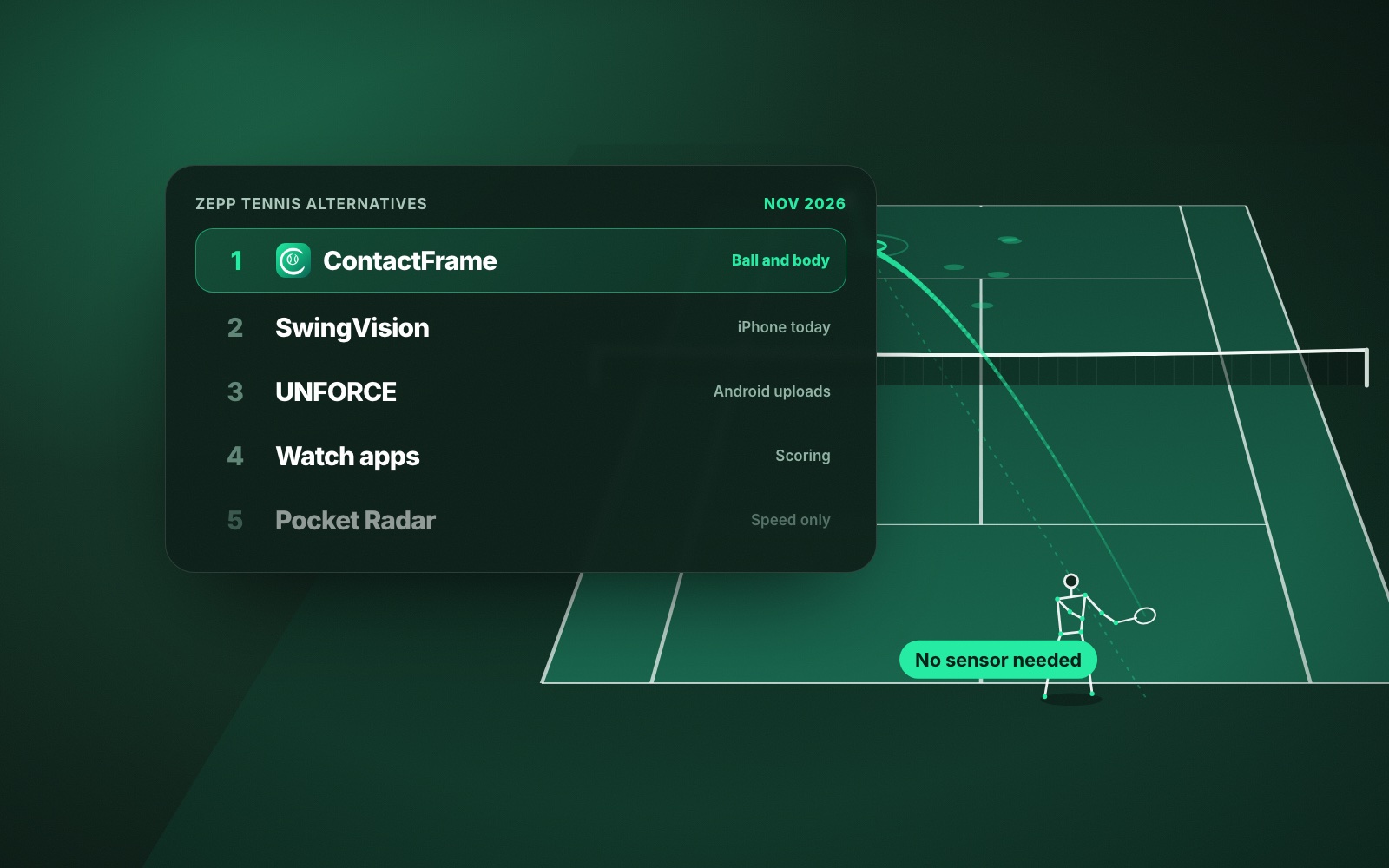
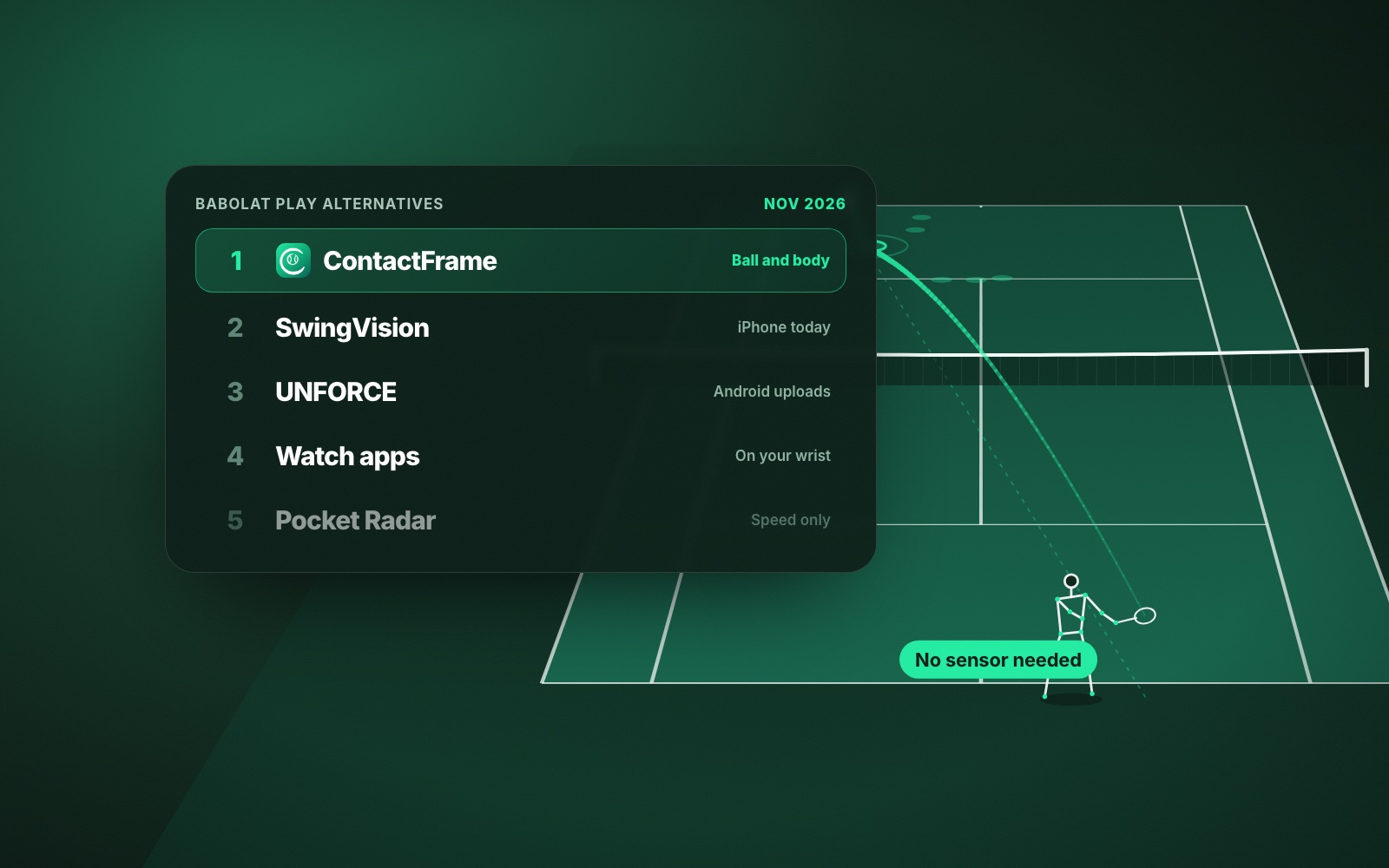
- ContactFrame: best overall for club players who want ball and body data from one phone
- SwingVision: best for iPhone and iPad owners who want a video app now
- UNFORCE: best for Android users who want an uploaded debrief
- Apple Watch tennis apps: best for a POP-style record on your wrist
- Pocket Radar: best for serve speed alone
1. ContactFrame: best Babolat Play replacement for club players
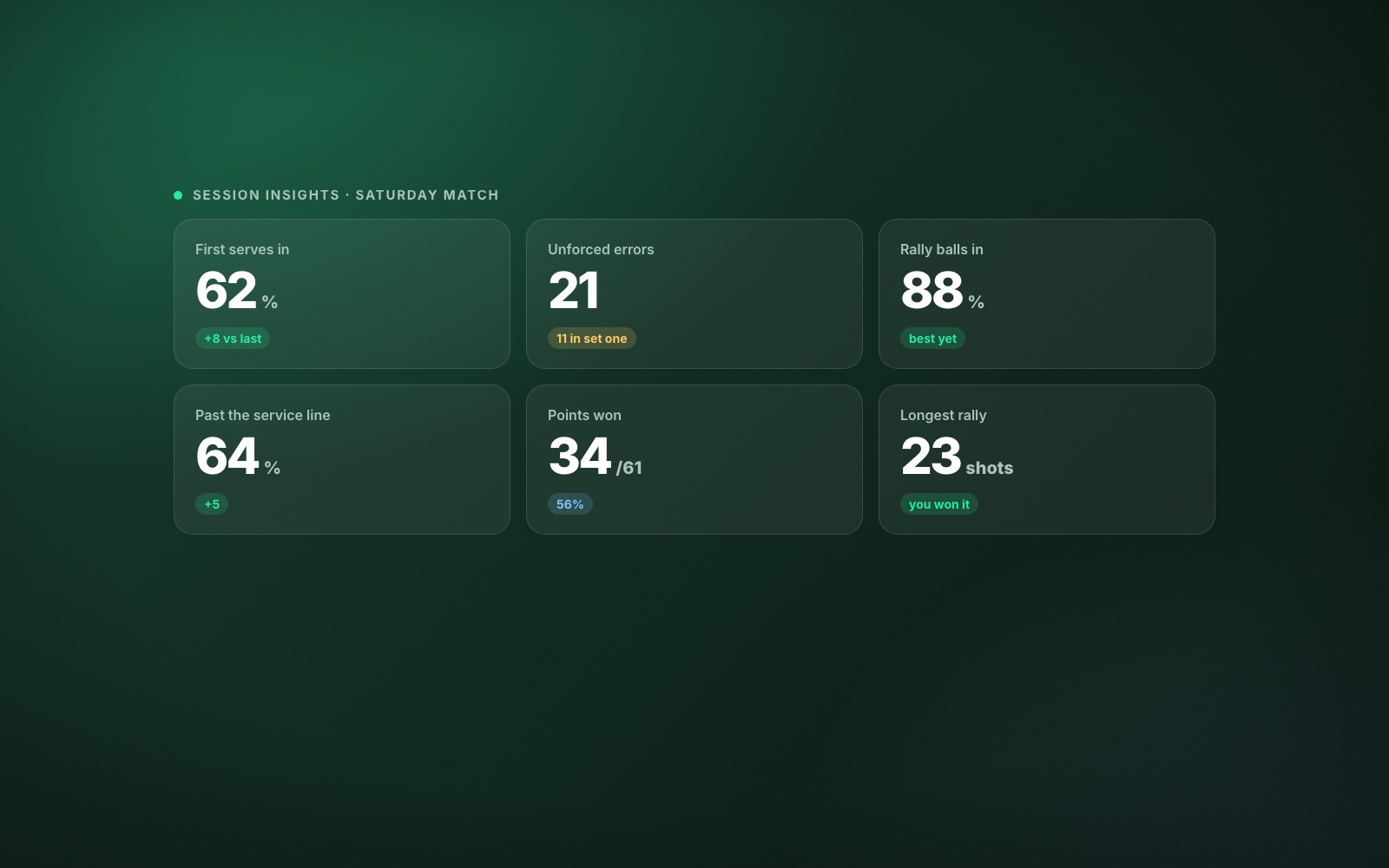
ContactFrame needs one phone on a tripod behind the baseline. For every shot it measures ball speed, spin in rpm with topspin or slice (shown only when the reading is solid), where the ball bounced, and an in, out or close call. It breaks a session down by serve, forehand, backhand, slice and volley, with how many of each landed in, and scores each shot out of 100. That overlaps with what Babolat Play recorded, such as stroke type and spin, with the result of every shot added.
It also tracks movement, and on Pro it adds shot mechanics: body points through the swing, swing scores, a stick-figure replay and one Next fix with a drill.
- Needs: a phone and a tripod. Keep your Play racket.
- Platforms: iOS and Android at launch. ContactFrame is not out yet; join the waitlist.
- Price (Nov 2026): Free £0 with 15 minutes of recording a month; Basic £9.99 a month, unlimited recording; Pro £17.99 a month with shot mechanics.
- Good at: ball and body in one app, rally and point breakdowns, trends over time, honest numbers (it leaves out what it is unsure of).
- Watch out for: small free tier, no Apple Watch app, no string-bed impact data, and in/out is for coaching, not official line calling.
2. SwingVision: best for iPhone and iPad owners now
SwingVision is a well-established tennis video app. It films from an iPhone or iPad and tracks shots, ball speed, placement, line calls and the score. If you want to start this week and you use Apple devices, try it. See swing.vision.
- Needs: an iPhone 11 or newer on iOS 18+, or an iPad on iPadOS 18+, and a mount.
- Platforms: Apple only, including Apple Watch. No Android app.
- Price (UK App Store, Nov 2026): free tier with 8 recording hours a month; Pro £24.99 a month or £179.99 a year (the annual plan works out cheaper per month).
- Good at: a much bigger free allowance than ours, Apple Watch control, scoring and full-court line calls on Pro.
- Watch out for: no Android. Its plan page lists shot stats and heatmaps for speed, depth and consistency; it does not list spin readings, movement or swing mechanics.
3. UNFORCE: best for Android users
UNFORCE, formerly AceSense, analyses a session you film on one phone and upload, returning a summary, clips and a debrief you can share with a coach.
- Needs: one phone.
- Platforms: Android and web; its site says iOS is not publicly available yet.
- Price (official site, Nov 2026): Pro €19 a month or €190 a year, 20 analyses a month, videos up to 30 minutes.
- Good at: available on Android today, coach sharing.
- Watch out for: euro pricing, and its homepage did not confirm speed or line-calling features.
4. Apple Watch tennis apps: closest to POP
POP lived on your wrist, and so do these. TennisKeeper uses the Apple Watch to count shots and record swing path, steps, distance and heart rate. Ballboy and Tennis Scoreboard keep score from the watch.
- Needs: an iPhone and an Apple Watch.
- Price (US store and official sites, Nov 2026): TennisKeeper free with add-ons (Pro Edition US$4.99 one-off); Ballboy free for 6 watch-tracked matches, then US$9.99 a year or US$24.99 lifetime; Tennis Scoreboard free with a US$9.99 upgrade.
- Good at: cheap and nothing to set up on court.
- Watch out for: no ball placement, in/out or video.
5. Pocket Radar: best for serve speed
A handheld radar measures ball speed directly, and the Smart Coach model pairs with an app that records video with the speed on it. Our serve speed radar guide compares the options.
- Price (official US site, Nov 2026): Smart Coach US$399.99; Ball Coach US$299.99.
- Good at: purpose-built for speed.
- Watch out for: speed only. No placement, spin or in/out.
How to choose a Babolat Play alternative
- If you used Play to see your spin and power, pick a video app that measures spin and speed on every shot.
- If you used it to count sessions and play time, a watch app is the cheapest swap.
- If you want to know why you lose points, you need placement and in/out, which of the options here only video gives you.
Verdict
Babolat Play was a racket that told you about itself. The better replacement tells you about the ball. ContactFrame is our pick for most club players because it measures speed, spin, placement and movement from one phone, on iOS and Android, priced in pounds. It is launching soon, so join the list for The Lab. If you need something this week on an iPhone, SwingVision is the one to use meanwhile. For the wider field, see the best tennis video analysis apps.
Common questions
Does the Babolat Play app still work?
No. Babolat told users the app would be maintained until 31 December 2021, after it stopped selling its connected devices on 1 March 2021. The racket itself still plays normally.
Is Babolat POP still supported?
No. The POP wristband was covered by the same notice as the Play rackets: sales stopped on 1 March 2021 and the app ran until 31 December 2021.
Can I still use my Babolat Play racket?
Yes. The sensor is built into the handle, but the frame and strings are a normal racket. You simply no longer get the stroke data in an app.
What replaced Babolat Play?
We found no major brand selling a racket sensor in November 2026. The live options are phone video apps, smartwatch apps and radars; video apps also show where the ball landed. ContactFrame is our pick once it launches; SwingVision is available on iPhone and iPad today.
Did Babolat offer refunds for Play rackets?
Babolat’s notice offered compensation to buyers after 1 January 2019. We could not confirm the details, so check with Babolat directly.
Keep the racket. Change the tracker.
ContactFrame measures every shot from one phone. It is coming to iOS and Android.
See The Lab