The short version
- UK courts fall into four groups: park courts, clubs, leisure and indoor centres, and schools. Each has different rules on who can play.
- Check surface, floodlights, booking rules and cost before you travel. A court that looks open on a map may need a booking or a gate code.
- Park courts are busiest on dry weekend mornings and summer evenings. Weekday daytimes and early starts are usually quiet.
- ContactFrame maps 1,300+ UK courts with filters and live availability where the venue publishes it. It does not take bookings.
- Pick a home court and play there often. Familiar opponents and a familiar bounce are worth more than a perfect surface.
Type “tennis courts near me” into a search box and you get a scatter of pins: a private club, a school with a locked gate, a park court that may or may not still have a net. What you wanted was simple. Where can I play, when, and what will it cost?
This guide explains the kinds of tennis courts you will find in the UK, who is allowed on each, what to check before you set off, and how to find one you will want to return to.
The four kinds of tennis courts in the UK
Public park courts
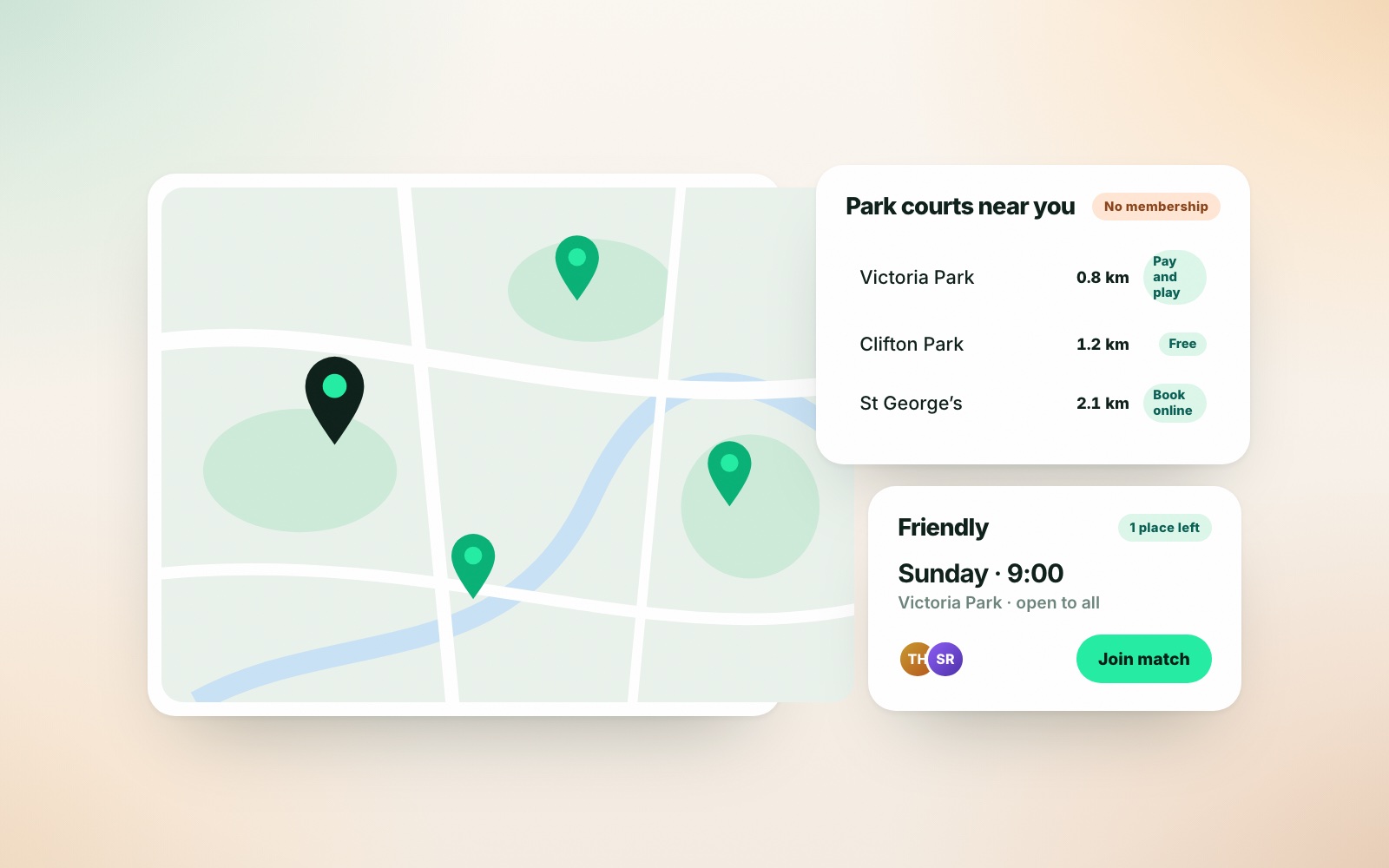
These are owned by the local council and open to everyone. Some are free. Many now charge a modest hourly fee or sell an annual pass, and booking has largely moved online. A good number have a gate that opens with a code sent to you when you book.
Quality varies a lot. Plenty of park courts have been resurfaced in recent years and are excellent. Others have cracks, moss and a net held up with string. A recent photo or a quick visit tells you which you are dealing with.
Tennis clubs
Clubs are run for members, but many are more open than they look from the gate. Some let visitors book a court for a fee, some run pay and play at quiet times, and most allow a member to bring a guest. Clubs also tend to have the things parks lack: floodlights, several surfaces and a clubhouse to shelter in when it rains.
Leisure centres and indoor tennis centres
These take bookings from the public by the hour. Indoor courts cost more, and in January they are worth it. If you want to play through the winter after work, an indoor or floodlit venue is the one thing you cannot do without.
Schools, colleges and universities
Some open their courts to the community in the evenings and at weekends, usually through a lettings office or a leisure operator. Availability changes with term dates, so check each time.
Finding public tennis courts near you
Start with your council. Search the council name with “parks tennis” and you will usually reach a page listing every public court in the area, with the booking link if there is one. It is the most accurate source for rules and prices, because the council sets them.
Then widen out. Clubs and leisure centres list their own visitor terms, though you often have to hunt for the page. Ask other players too. The best court in town is frequently one that looks unpromising online and is known only to the people who use it.
The quicker way is a map that puts all of them together. That is the job of the court finder in ContactFrame.
How the ContactFrame court finder works
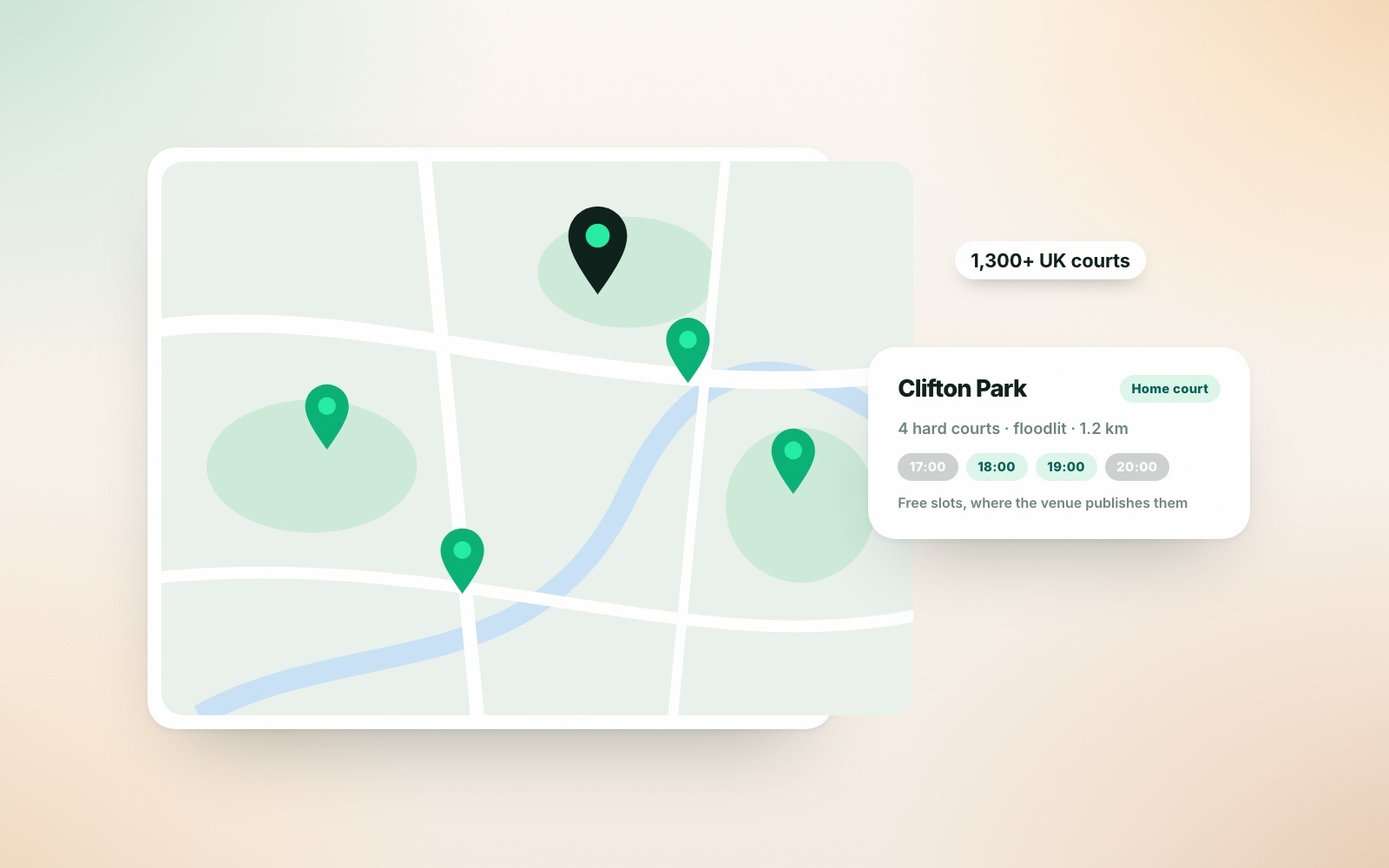
ContactFrame has a map of more than 1,300 courts across the UK, and it is free to use. You can filter by surface, by distance and by whether the venue is bookable, so a search for a hard court within a short drive takes a few seconds.
Where a venue publishes its availability, ContactFrame shows it live, so you can see whether there is a free court this evening before you get in the car. Not every venue publishes this, and where it does not, the app does not guess.
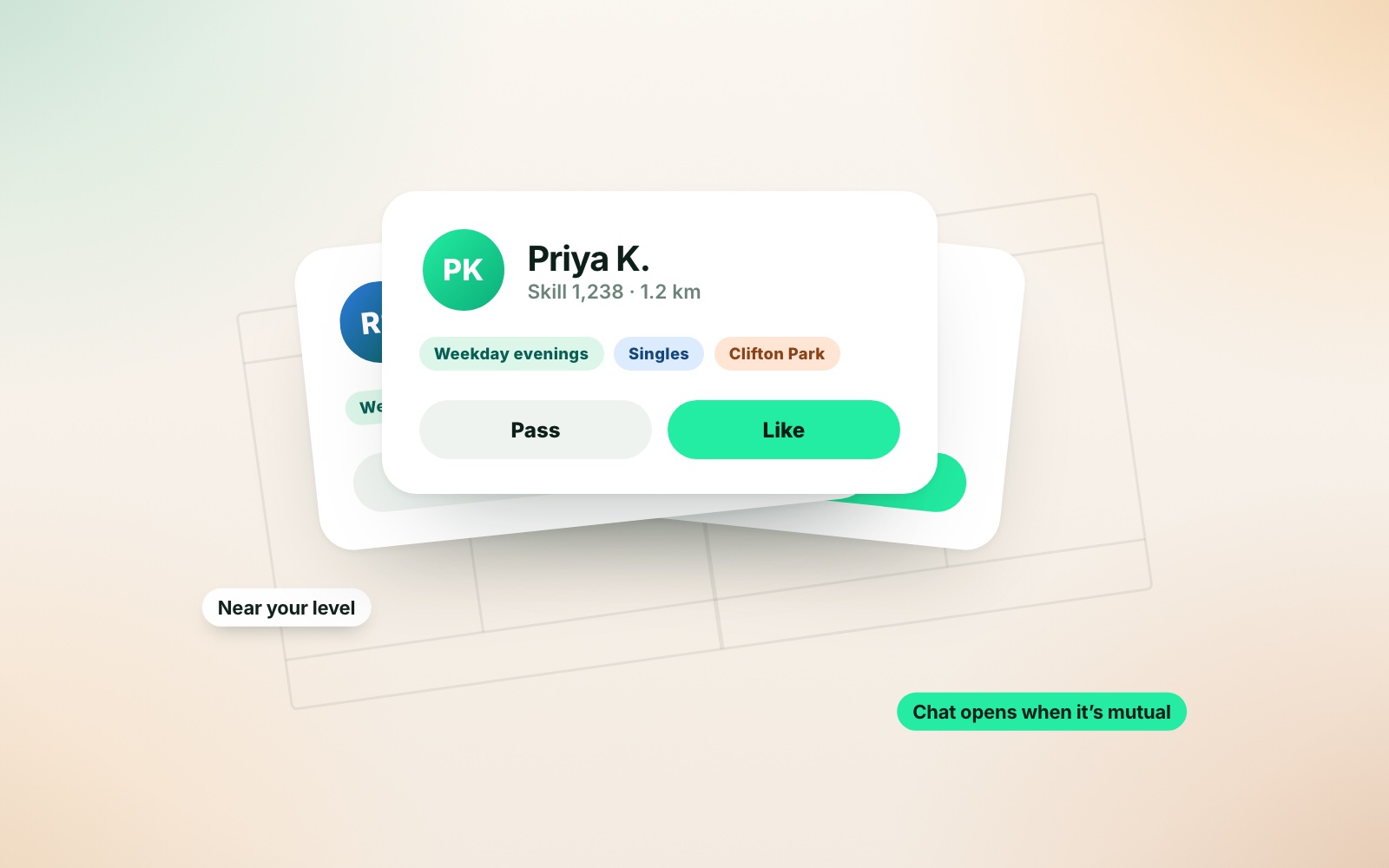
Each court page also shows who plays there. That matters more than it sounds, because a court is only half of what you need. The other half is someone to play with, and the players at your nearest court are the ones you are most likely to meet regularly.
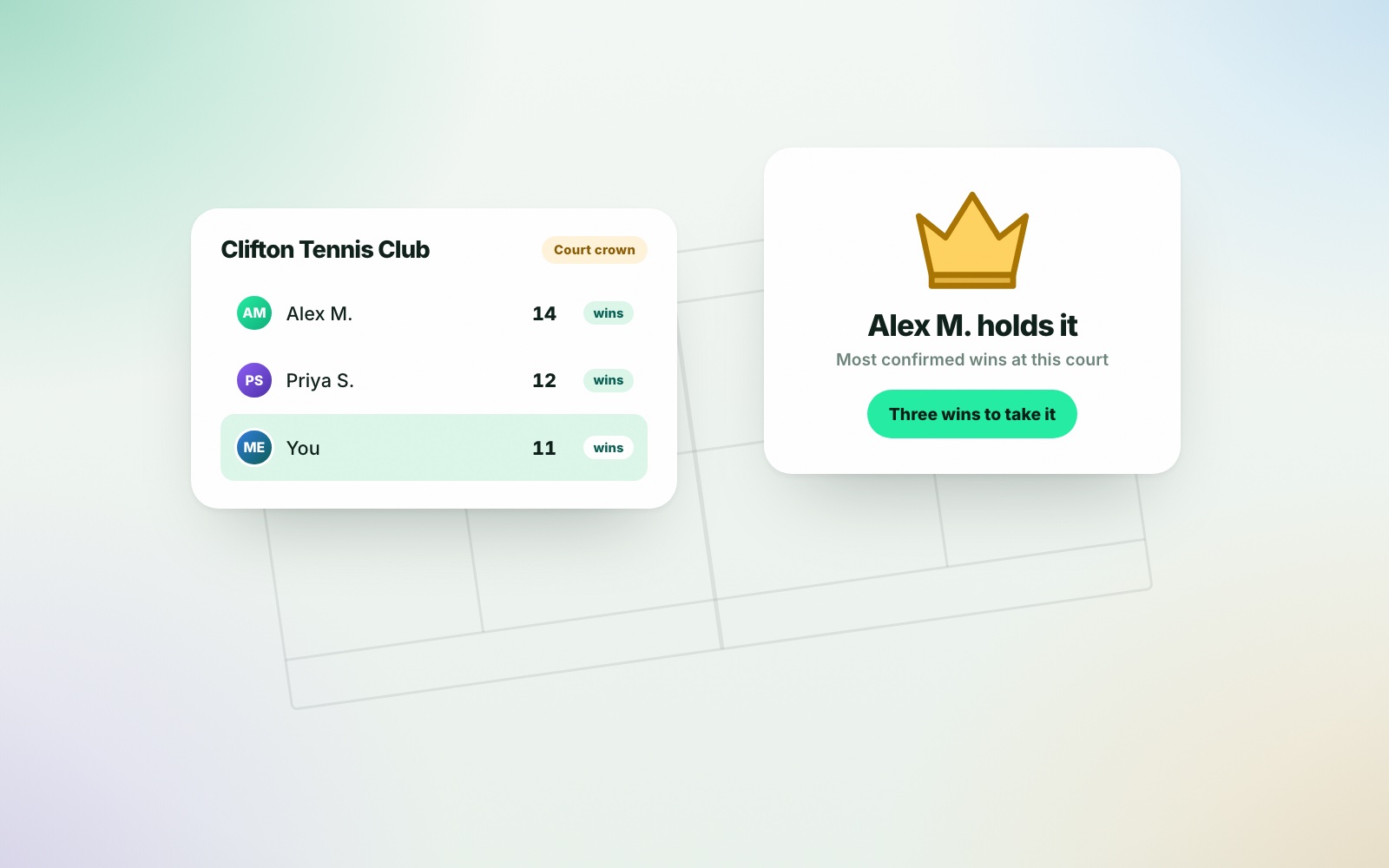
You can set one venue as your home court. Rankings on The Ladder begin there, and the player with the most confirmed wins at a court holds its crown. The story behind that is in every court has a crown.
What to check before you travel to a court
Five minutes of checking saves a wasted trip.
- Booking. Is it turn up and play, or do you need a slot? Is there a gate code?
- Cost. Free, hourly or by annual pass? Is the price per court or per person?
- Surface. Hard, artificial grass, artificial clay or real grass. Grass is usually summer only.
- Floodlights. Essential from October to March if you play after work. Check whether lights cost extra.
- Nets. Some councils take nets down for the winter. It is rare now, but it happens.
- Footwear rules. Clubs with artificial grass or clay sometimes insist on tennis shoes with the right sole.
- Room behind the baseline. If you plan to film, you need space for a tripod two to three metres back. Tight park courts with a fence close behind can make that awkward. See the best phone setup for filming tennis.
Which tennis court surface should you look for?
Most UK park courts are hard courts, usually painted macadam. The bounce is true and medium paced, and they drain reasonably well. They are the sensible default.
Artificial grass is common at clubs. The ball stays low and skids, which rewards slice and flat hitting and punishes a late swing. It plays well in drizzle and can be slippery when sanded surfaces are very wet.
Artificial clay is slower and higher bouncing, with longer rallies and a softer feel underfoot. Real grass is a treat and rarely available outside late spring and summer.
If you play matches on one surface, practise on it. The same shot behaves differently on each, and timing that feels grooved on a hard court can desert you on artificial grass.
When park tennis courts are quiet
Demand follows the weather and the working week. Dry Saturday and Sunday mornings are the busiest, followed by summer evenings from about six. The fortnight of Wimbledon fills every park court in the country.
Quiet times are weekday daytimes, early mornings, and any dry day between November and February. If your court is turn up and play, an 8am start at the weekend nearly always gets you on.
After rain, give a hard court a little time and take a towel for the lines, which stay slippery longest. Do not play on a court with standing water or frost.
Choose a home court and stick with it
It is tempting to chase the best surface in the county. In practice, the court you can reach in ten minutes is the one you will play on every week, and playing every week is what improves your tennis.
A regular court gives you a bounce you know, faces you recognise and, in time, a few rivals. If you do not belong to a club and do not want to, that is no barrier: playing without a club membership is easier than it used to be, and a good park court is where it starts.
Common questions
How do I find tennis courts near me in the UK?
Look at your council’s parks pages for public courts, then check nearby clubs and leisure centres for pay and play. A court finder with a map and filters, such as the one in ContactFrame, shows them in one place so you can compare distance, surface and whether they are bookable.
Are public tennis courts free in the UK?
Some are, and many now charge a small hourly fee or offer an annual pass. It varies by council and sometimes by park, so check the venue’s own page before you go.
Do I need to book a park tennis court?
Often, yes. Many park courts have moved to online booking, and some have a gate that opens with a code sent when you book. Others are still turn up and play. The venue’s page will say which.
Can I book a tennis court through ContactFrame?
No. ContactFrame shows you where courts are, what they are like and, where the venue publishes it, when they are available. You book and pay with the venue itself.
What is the best tennis court surface for a club player?
The one you will play matches on most often. Hard courts give the truest bounce, artificial grass is fast and low, and artificial clay is slower and kinder on the legs. Each rewards slightly different shots, so practising on your usual match surface makes sense.
See every court around you.
Join the list for ContactFrame and get a map of 1,300+ UK courts, with who plays at each one.
See The Ladder