The short version
- A club bundles courts, people, competition and coaching. Outside a club you assemble those four yourself.
- Park courts and pay and play cover the court. Check booking rules and floodlights before relying on one venue.
- People are the hard part. Social sessions, friendlies and local leagues replace the club noticeboard.
- You do not need a membership to play matches that count towards a rating.
- Winter is the real test. Find a floodlit or indoor option before the clocks change.
You want to play tennis regularly, but a club is not for you. Maybe the nearest one has a waiting list, the fees do not make sense for how often you would go, or you just do not fancy committees and club nights. The good news is that you can play tennis without a club membership and miss very little.
It helps to be clear about what a club is really selling. Then you can replace each part on your own terms.
What a tennis club gives you, and how to replace it
Strip away the clubhouse and a membership is a bundle of four things:
- Courts you can get on without much fuss.
- People to play with, at a range of levels.
- Competition: box leagues, club tournaments, team matches.
- Coaching and a sense of structure.
Outside a club you assemble these yourself. Courts are the easy one. People are the hard one. The rest of this guide takes them in turn.
Courts: park tennis and pay and play
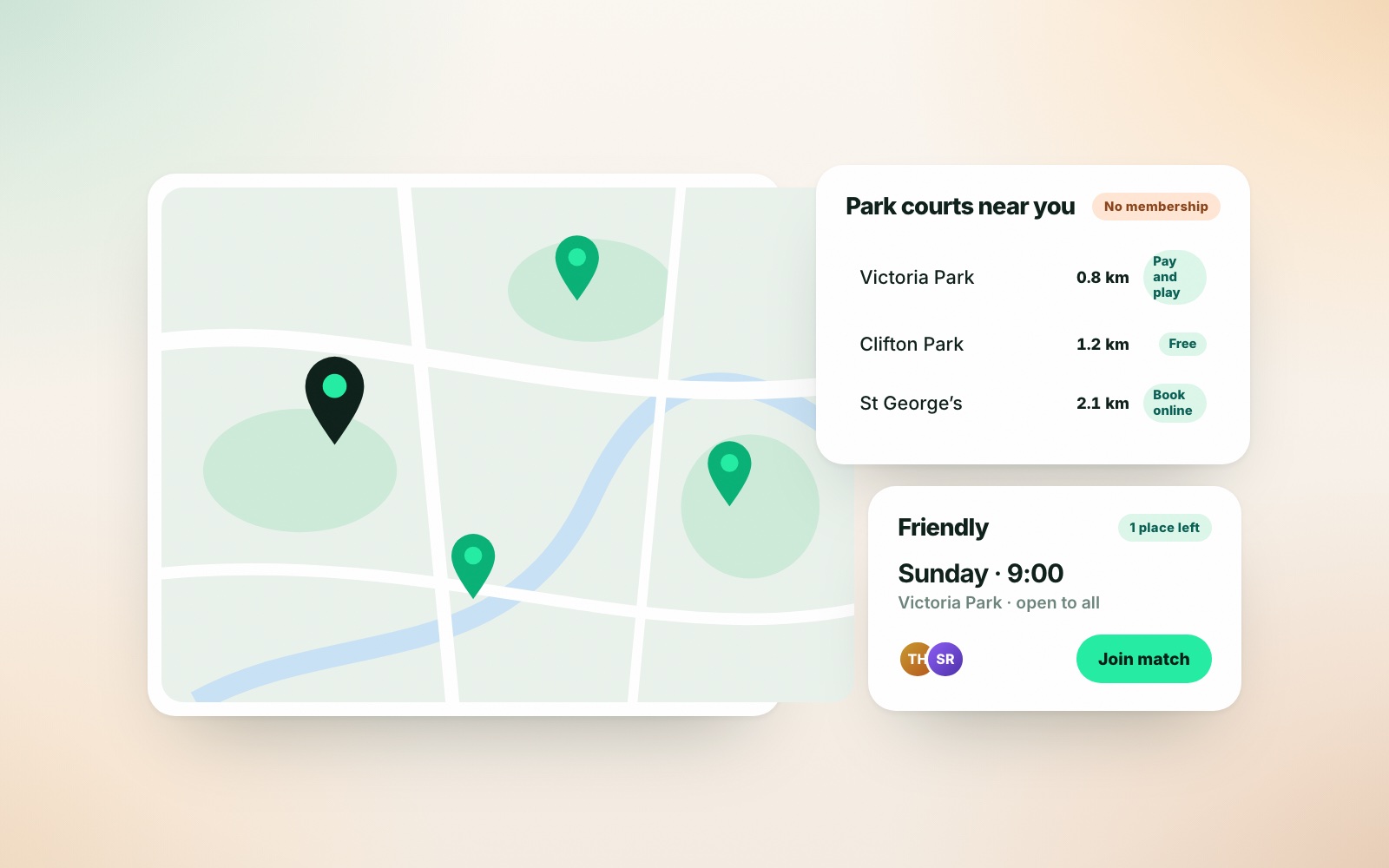
Council park courts are the backbone of tennis without a club. Some are free and many charge a small hourly fee or sell an annual pass, with booking online. Leisure centres hire courts by the hour, and a fair number of clubs offer pay and play to non-members at quieter times.
Before you rely on a venue, check three things: whether you need to book, what it costs, and whether it has floodlights. The full checklist is in how to find tennis courts near you in the UK.
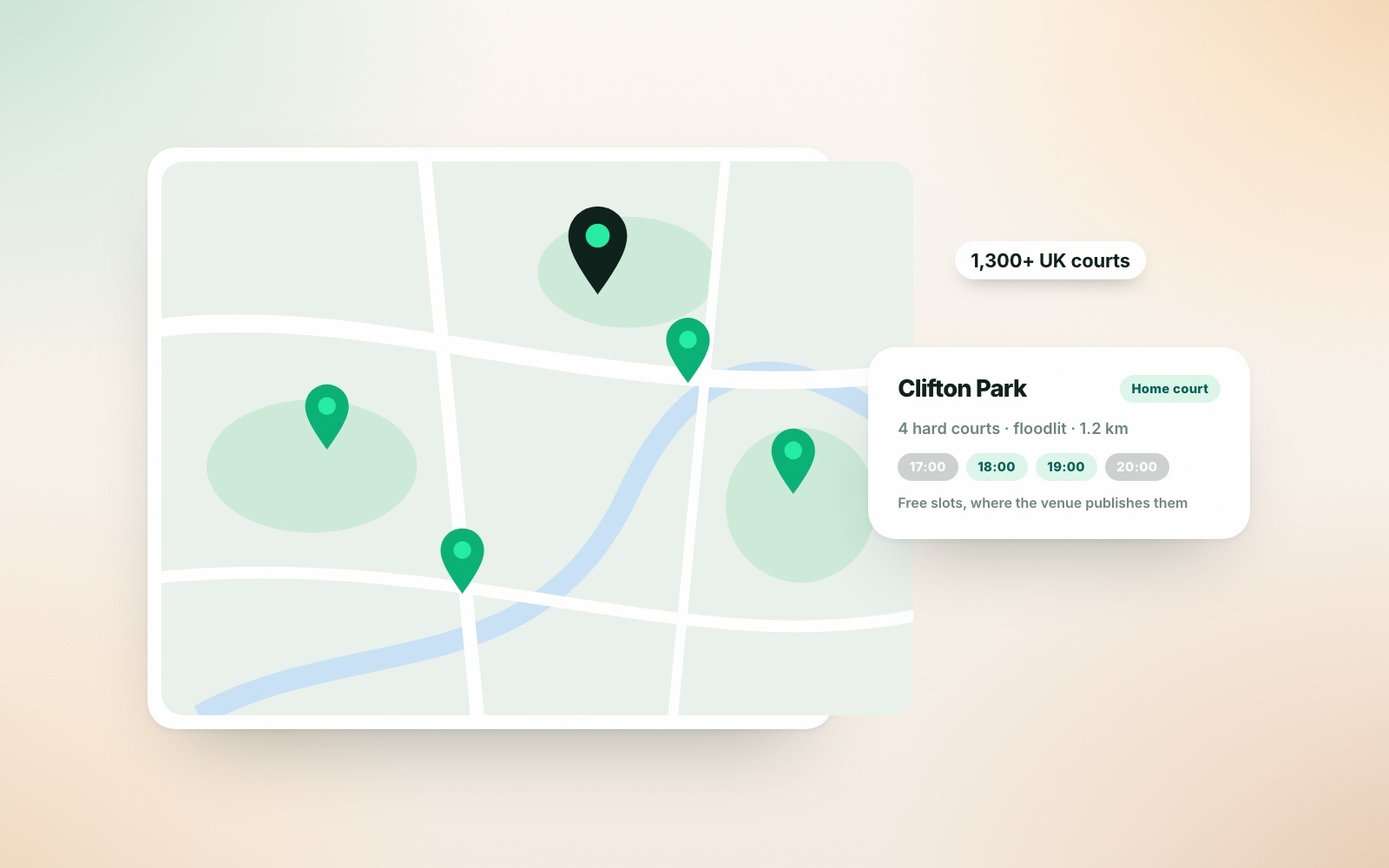
The court finder in ContactFrame puts more than 1,300 UK courts on one map, with filters for surface, distance and whether a venue is bookable, and live availability where the venue publishes it. It shows you the court. You book with the venue itself.
People: finding tennis matches without a club
This is where non-members usually get stuck. A club is, above all, a room full of people who play tennis. Without it you need another source.
- Drop-in sessions. Many parks run social tennis open to anyone, often at weekends. They are friendly, cheap and the best way to meet local players quickly.
- Group coaching. Adult groups in parks give you a regular slot and a set of people at a similar standard.
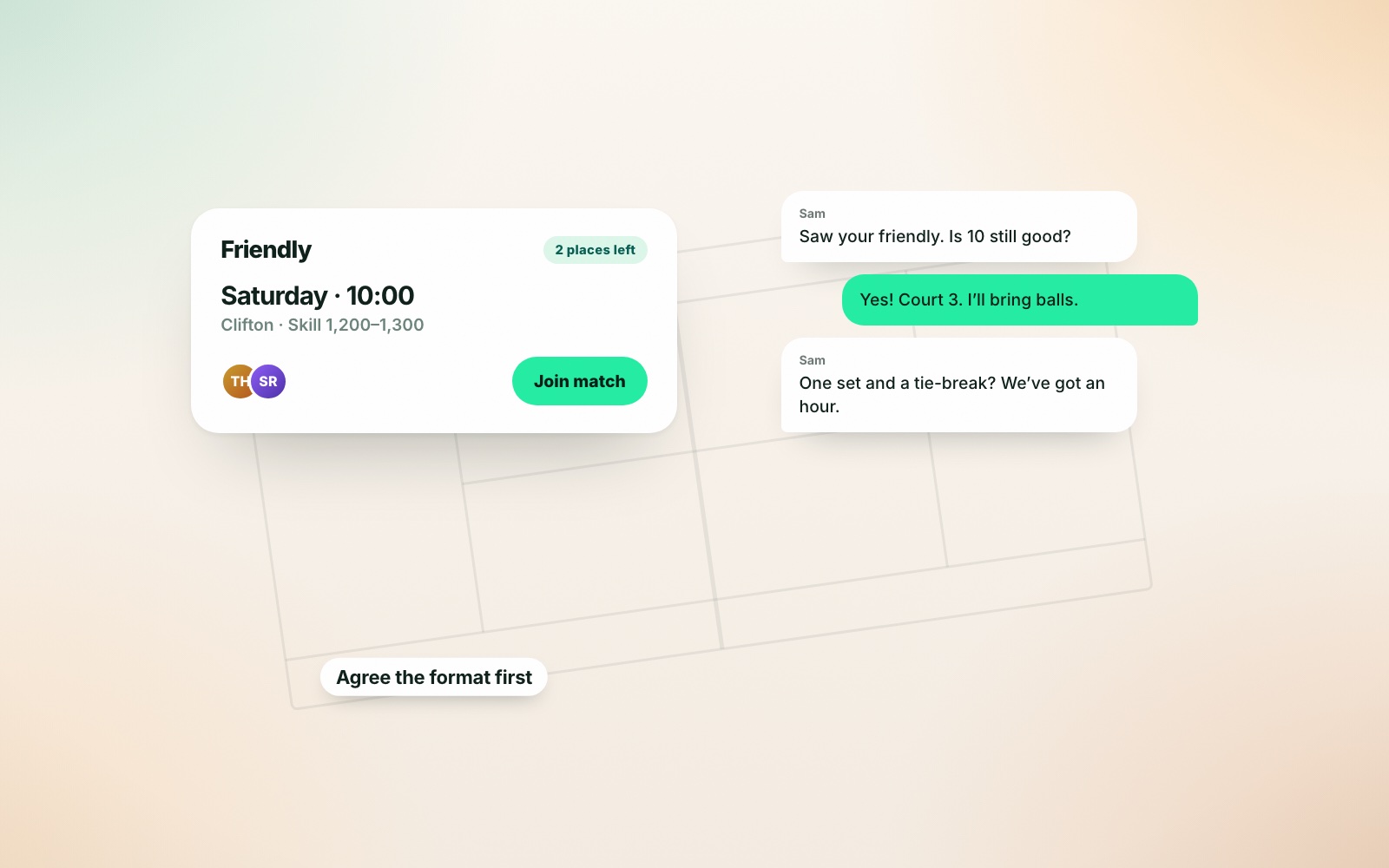
- Friendlies. On ContactFrame you can post a match with a skill range, a court and a time, and others join. You can also join one somebody else has posted. See how to arrange a friendly.
- MatchMe. Like or pass on nearby players. A chat opens only when the interest is mutual.
- Your home court. Set one in the app and you can see who else plays there.
Aim to build a small circle of two or three regulars. Finding tennis partners near you covers how to do that and how to keep them.
Competition: matches that count without a membership
Club members get box leagues and tournaments handed to them. You can have the same thing without the membership.
Local leagues for individual players run in parks across the UK. You are grouped with players of a similar standard, you arrange each match between you, and you play on public courts. How local tennis leagues work explains the format.
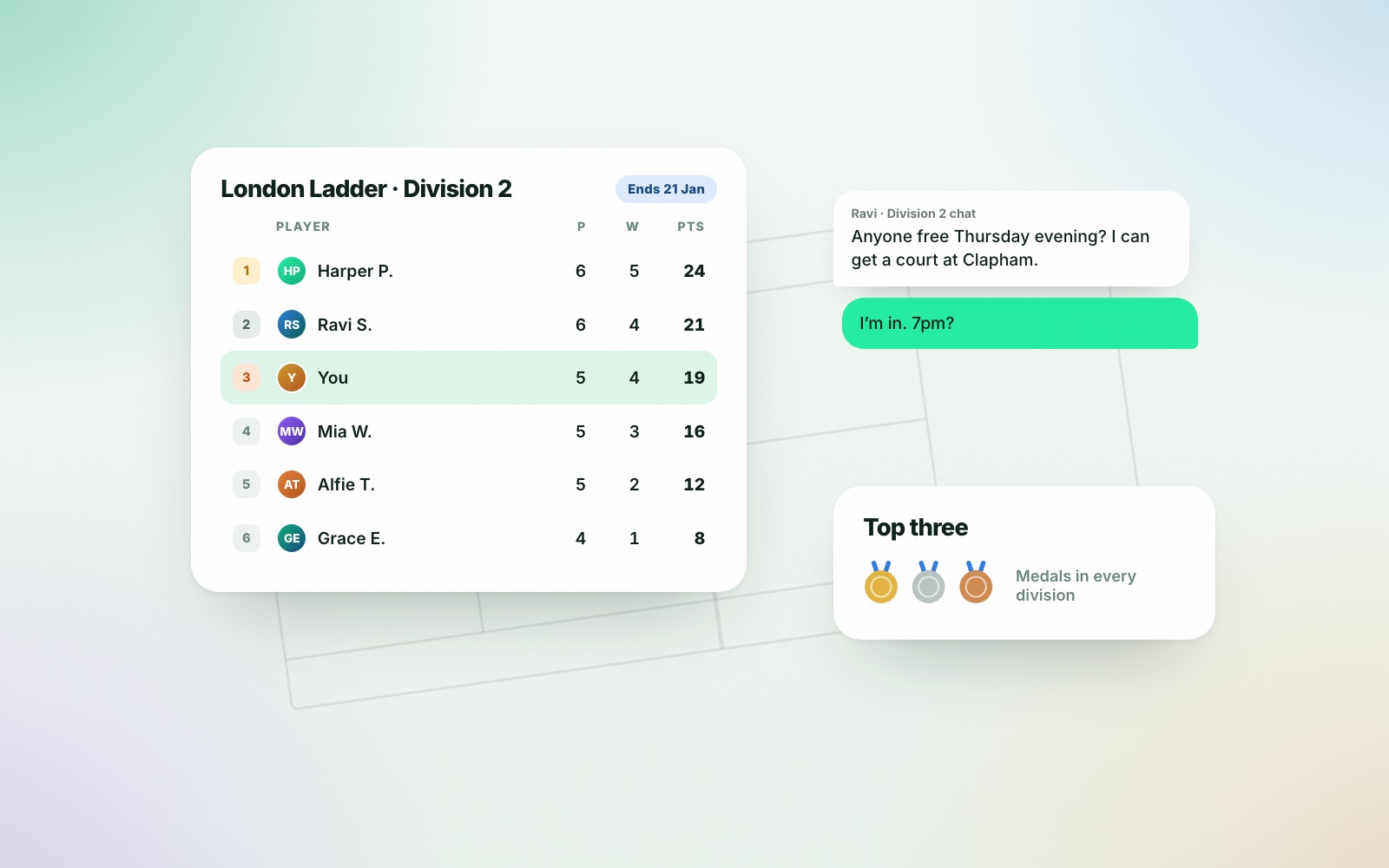
On The Ladder in ContactFrame, joining is free and no club is involved at any point. Your Skill rating is built from confirmed results. One player logs the result and the opponent confirms it, and a result nobody disputes is confirmed automatically after 24 hours.
From there you can enter a league, where you are placed in a division with players at your level, each with its own table and group chat. Or a tournament: a knockout draw seeded by Skill, with the first round drawn close to home and a deadline on every round. Each league or tournament entry costs one credit. Friendlies and rankings cost nothing.
If you have never played a match that counted, starting competitive tennis as an adult walks through the first one.
Coaching and improving on your own
You do not need to be a member to have lessons. Many coaches work on park courts and take individual bookings, and a lesson every few weeks with practice in between is a sound way to improve.
Between lessons, the difficulty is knowing whether your practice is working. A club player has team-mates to tell them. You can use video instead. With a phone on a tripod behind the baseline, ContactFrame measures ball speed, spin, where each shot bounced and whether it was in, out or close, then shows the same measures session after session.
That will not replace a coach’s eye. It does give you something to take to a coach, and a way to check that the thing you worked on has changed. The article on practising tennis alone has sessions that need no partner at all.
What playing without a club costs
The honest answer depends on how often you play. Roughly, your spending falls into four lines:
- Court hire. Nothing at a free park court, a few pounds an hour at most paid ones, more for indoor courts. Usually split between two.
- Balls. A fresh tin every few sessions. Take turns with your partner.
- Competition. League and tournament entry fees, where you choose to enter.
- Coaching. As much or as little as you want.
If you play once a week in the warmer months, pay as you go is almost always cheaper than a membership. If you play three or four times a week all year, add it up properly, because a membership may win on cost per hour. There is no shame in changing your mind later.
The catch: winter and wet weather
Summer tennis without a club is easy. November to February is where it falls apart. It is dark by late afternoon, many park courts have no lights, and the weather cancels plans.
Three things keep you playing:
- Find one floodlit venue. A park with lights, a leisure centre or a club offering pay and play in the evening. Sort this out in October.
- Move to daylight. A fixed weekend morning slot survives the winter better than a weekday evening.
- Budget for a few indoor sessions. They cost more, and one a fortnight keeps your timing alive until spring.
Is it worth joining a club later?
Possibly. Clubs suit people who want team tennis, a social life built around the game, and several surfaces and floodlights on tap. If that becomes you, join one, and the partners and results you have built outside will come with you.
Until then, a decent park court, two or three regular opponents and a league to give the season some shape is a full tennis life. Plenty of very good players have never had anything else.
Common questions
Can I play tennis without a club membership in the UK?
Yes. Public park courts, leisure centres and many clubs offering pay and play are open to non-members. You book by the hour or turn up, depending on the venue.
What is pay and play tennis?
It means paying for a court by the hour without being a member. Parks, leisure centres and some clubs offer it. Prices and booking rules vary by venue, so check the venue’s own page.
How do I find people to play tennis with if I am not in a club?
Try drop-in sessions at parks, local leagues and apps that show nearby players by level. Posting a friendly with a time, a court and a skill range is one of the quickest ways to get a match.
Can I play competitive tennis without joining a club?
Yes. Local leagues and ladders are open to individual players and use public courts. On ContactFrame, leagues and tournaments are open to anyone on the ladder, and each entry costs one credit.
Is playing in a park cheaper than joining a tennis club?
For someone who plays occasionally, usually yes. For someone who plays several times a week, a membership can work out cheaper per hour. Work it out from how often you will really play.
No membership. Still a tennis life.
Join the list for ContactFrame: courts on a map, friendlies near you and a ladder that is free to join.
See The Ladder