The short version
- A ball machine gives you the same ball every time, which makes it the fairest test of your own shot.
- Give every block of balls one purpose and one number to judge it by.
- Set the machine to a realistic rally pace. Maximum speed teaches survival, not technique.
- Short blocks of 15 to 20 balls with rest between them beat one long tired basket.
- Finish with a varied feed, then test the change in a real rally or match.
Search for ball machine drills and you will find hundreds. The drills are not the hard part. The hard part is that an hour on the machine always feels useful. You hit three hundred balls, you sweat, a good share of them go in, and you leave satisfied. Then the weekend match looks exactly like the last one.
The machine is not at fault. It is the most patient practice partner there is. What is missing is a measurement: something that says whether block four was better than block one, and whether this week beat last week.
Why ball machine practice often doesn’t transfer
With a machine, rhythm arrives for free. The ball comes to the same place at the same pace, so by the tenth ball you are timing it well, and that feels like improvement. Much of it is you adjusting to the feed.
It is also easy to hit without a target. A ball that lands anywhere in the court counts as good when nobody is on the other side to punish it. And long baskets hide fatigue: the last fifty balls are often hit with a shorter, lazier swing than the first fifty, and those are repetitions too.
None of this is a reason to avoid the machine. It is a reason to measure what you do on it.
How to film a ball machine session
Put your phone on a tripod behind your own baseline, two to three metres back, in landscape and at net height or higher. The whole court needs to be in view, including the machine’s end. Keep the phone still for the session and avoid pointing it into the sun. In ContactFrame, choose the Ball machine session type and line up the four corners of the court.
Hitting from the end nearest the camera matters on the Pro plan, because shot mechanics covers the player nearest the camera. Pick a session focus that matches the day’s job: Depth, Consistency, Topspin, Power or Placement. For more on positioning, see the best phone setup for filming tennis.
Which numbers to check after a ball machine session
- Shots in, by shot type. The plainest test. How many of your forehands, backhands, slices or volleys landed in.
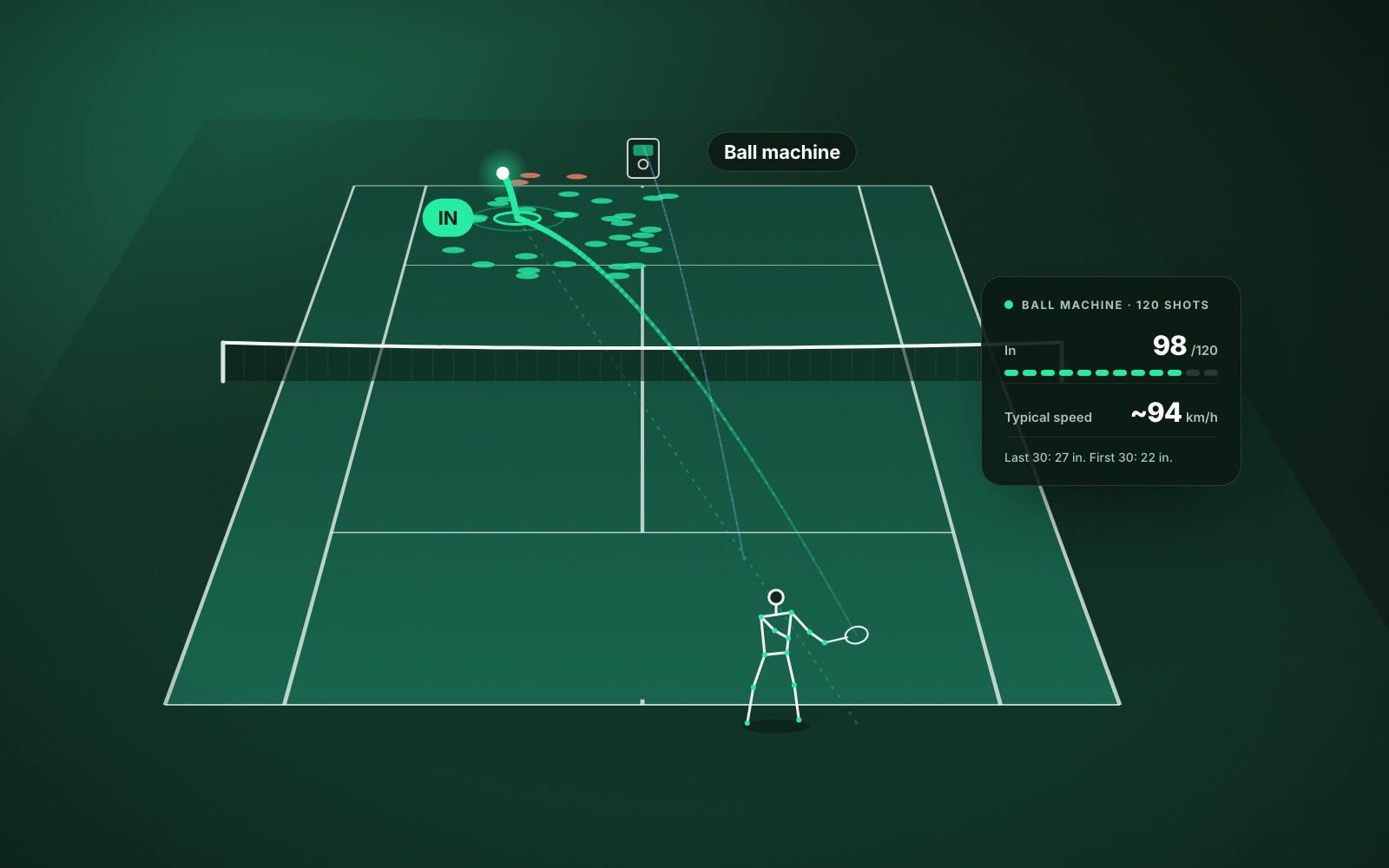
- The shot placement map. With an identical feed, the spread of your bounces is a direct picture of how repeatable your swing is.
- Speed and spin by shot type. Useful for comparing one block against another, for example a block hit flat and a block hit with more shape.
- Shot quality. A score out of 100 for each shot and for the session, handy as a single figure to compare weeks.
- Movement. How well you recovered to the middle between balls, which matters as soon as the feed starts moving you.
Four ball machine drills and how to measure them
1. The fixed-feed test
Set a steady feed to your forehand at a normal rally pace. Hit twenty balls cross-court to a target area you have marked a metre or two inside the lines. Rest. Repeat on the backhand. This is your reference block, and you should hit it at the start of every machine session.
The number to watch: shots in out of twenty on each wing, and how tight the group is on the placement map. Because the block never changes, it is the cleanest week-to-week comparison you have.
2. Two-line feed with recovery
Set the machine to alternate between forehand and backhand, with enough time between feeds to get back to the centre mark. Hit each ball cross-court and recover fully before the next one leaves the machine. If you find yourself standing and waiting on one side, widen the feed or shorten the interval slightly.
The number to watch: recovery to the middle in the movement figures, plus shots in. A good block keeps both high. If accuracy collapses as soon as you have to move, footwork is your next project.
3. Short ball, approach and volley
Set a shorter, slower feed that lands around the service line. Move in, hit the approach deep down the line, and continue forward to play a shadow split step at the net. If your machine can feed two balls in sequence, take the second as a volley.
The number to watch: where the approach shots bounce on the placement map. They should be deep and near the side you aimed for, not sitting mid-court. For volleys, check how many landed in. This volley guide has more drills.
4. The mixed feed
Finish with the machine on its random or oscillating setting, if it has one, so you do not know which side is coming. Play each ball to a safe cross-court target. This is the closest a machine gets to a real rally, and it shows whether the earlier blocks survive a little uncertainty.
The number to watch: shots in and shot quality for this block against your fixed-feed block. The gap between the two is how much of your accuracy depends on knowing what is coming.
How to re-measure, and what progress looks like
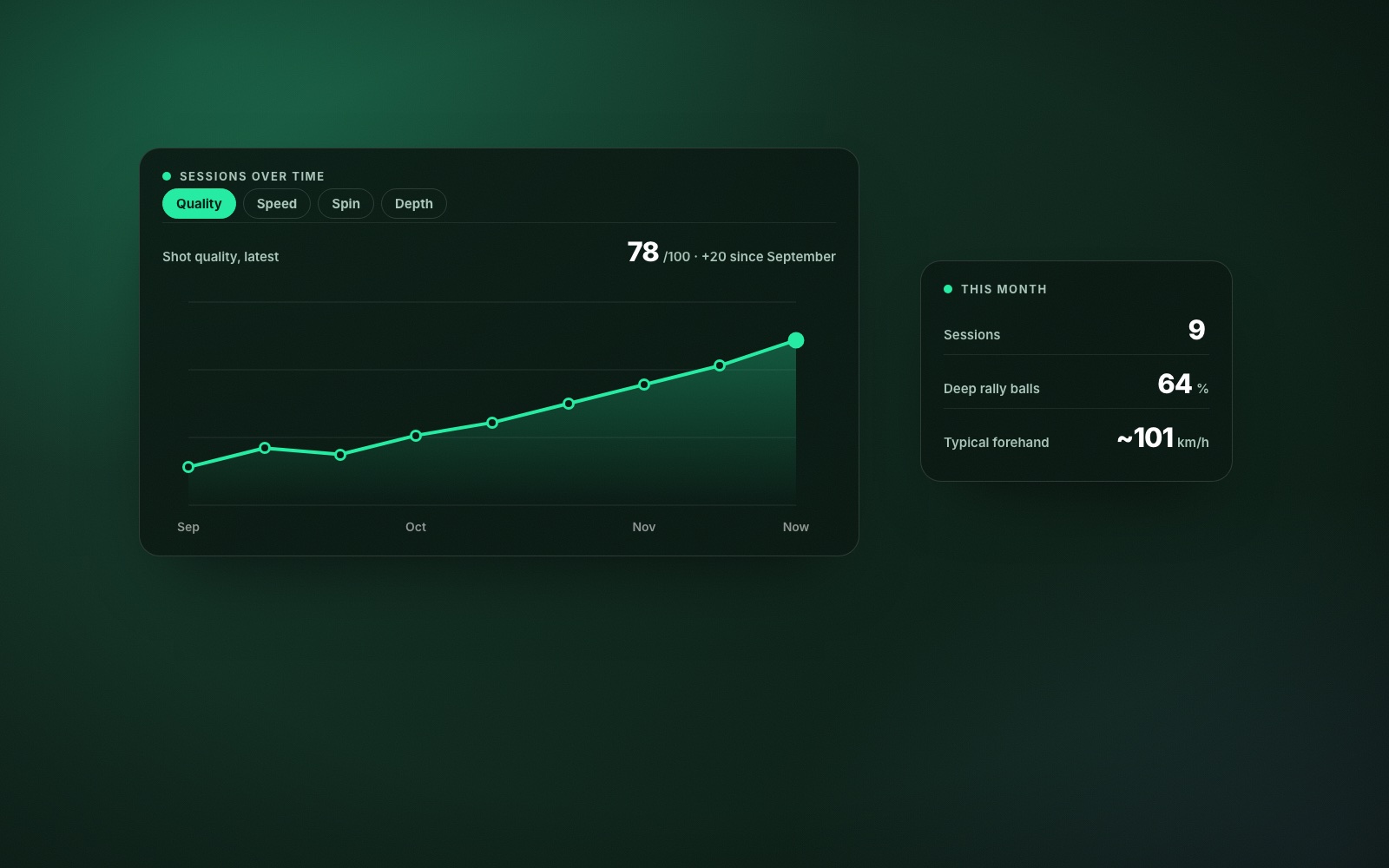
Keep the machine settings the same from week to week and write them down: pace, interval and where it is aimed. Then compare sessions in Trends. Because the feed is constant, even small changes in your numbers mean something. How to track your tennis progress explains what to compare.
On a fixed feed, expect to see a difference within three or four sessions. That is the quick part. Holding the same numbers in the mixed feed takes longer, and holding them in a match longer again. Plan on six to eight weeks before a machine-built change shows up in your results.
What a ball machine and video can’t teach you
A machine does not disguise its shots, vary its spin from ball to ball or punish a weak reply. Reading an opponent and making decisions under pressure have to be learned against a person. Film a Practice or Match session regularly to check the machine work is carrying over.
As for the analysis, it measures the ball and, on Pro, scores your swing and suggests a Next fix. ContactFrame does not analyse grip or racket-face angle. A machine will happily let you groove a flaw three hundred times an hour, so if a number will not move, have a coach look at the stroke before you hit another basket. If no partner is free at all, practising alone covers other options.
Common questions
Are ball machines good for improving at tennis?
Yes, for building and testing a stroke, because the feed is consistent and you get a lot of repetitions quickly. They are less good for learning to read an opponent or handle varied balls. Use a machine alongside rallies and matches, not in place of them.
What are the best ball machine drills for beginners?
Start with a steady feed to one side at a gentle pace and hit cross-court to a large target, twenty balls at a time. Add the other wing, then alternate between the two. Move on to short balls and volleys once you can keep most of a block in court.
How long should a ball machine session be?
Forty-five minutes to an hour is plenty for most club players, including rests and ball collection. Quality drops sharply once you are tired, and tired swings are the ones you end up grooving. Several short focused blocks are worth more than one long one.
Can I track my ball machine practice with an app?
Yes. ContactFrame has a Ball machine session type that measures your shots off the feeder: speed, spin, where each ball bounced and whether it was in, out or close, broken down by shot type. You film it with one phone on a tripod.
How fast should I set the ball machine?
Set it to roughly the pace of a ball you face in your normal matches, with enough time between feeds to recover to the middle. If you are late on most balls or cannot keep a block in court, it is too fast or too frequent for the drill you are doing.
Make every basket count.
Film your ball machine session and see what each block really did.
Explore The Lab