The short version
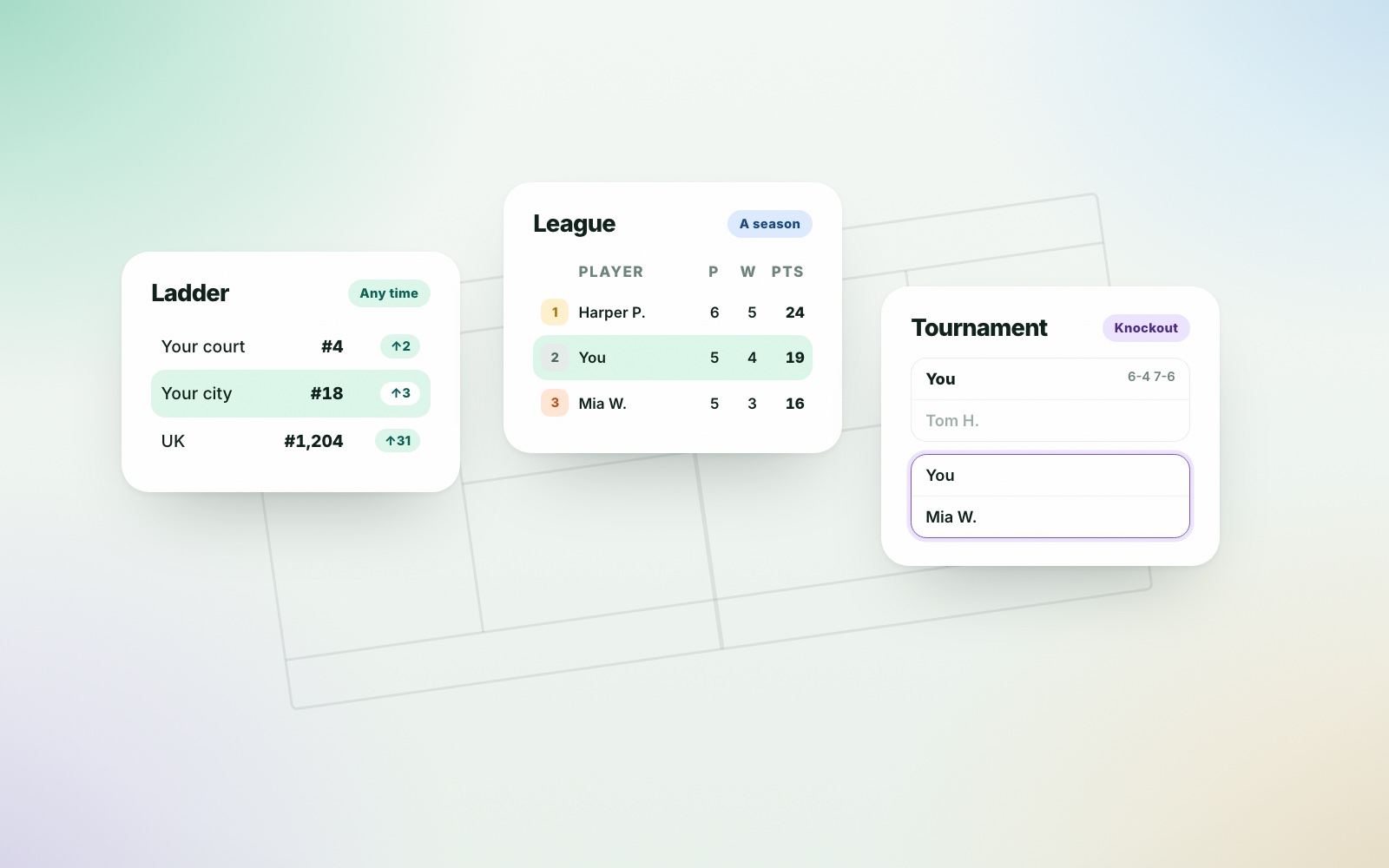
- A ladder is open-ended: play when you like and your position moves with your results.
- A league gives you a fixed group and a fixed window. It suits players who want regular, even matches.
- A tournament is a knockout: high stakes, a clear winner, and no guarantee of more than one match.
- Choose by time and temperament, not ability. Every format works at every standard if players are sorted properly.
- On ContactFrame all three sit on the same Skill rating, so you can mix them freely.
You want proper matches, the kind where the result counts, and you are immediately asked to choose between words that sound like the same thing. The tennis ladder vs league question comes up first, and then someone mentions a tournament. All three are competitive, all three involve playing strangers, and people use the names loosely.
They are different in ways that matter to your week. This article sets out what each one asks of you and which kind of player tends to enjoy it.
Tennis ladder vs league: the short version
A ladder never ends. A league has a start and a finish. A tournament ends for you the moment you lose.
Nearly everything else follows from that. An open-ended format is flexible but can drift. A fixed window creates urgency but needs commitment. A knockout creates drama but gives no promise of a second match.
What is a tennis ladder?
A ladder is one ongoing list of players in order. You play, the result is recorded and the order changes.
In the traditional club version, names sit on a board and you challenge someone a few places above you. Win and you take their spot. Newer ladders drop the challenge rules and rank players by a rating built from their results, which means any match against any player counts.
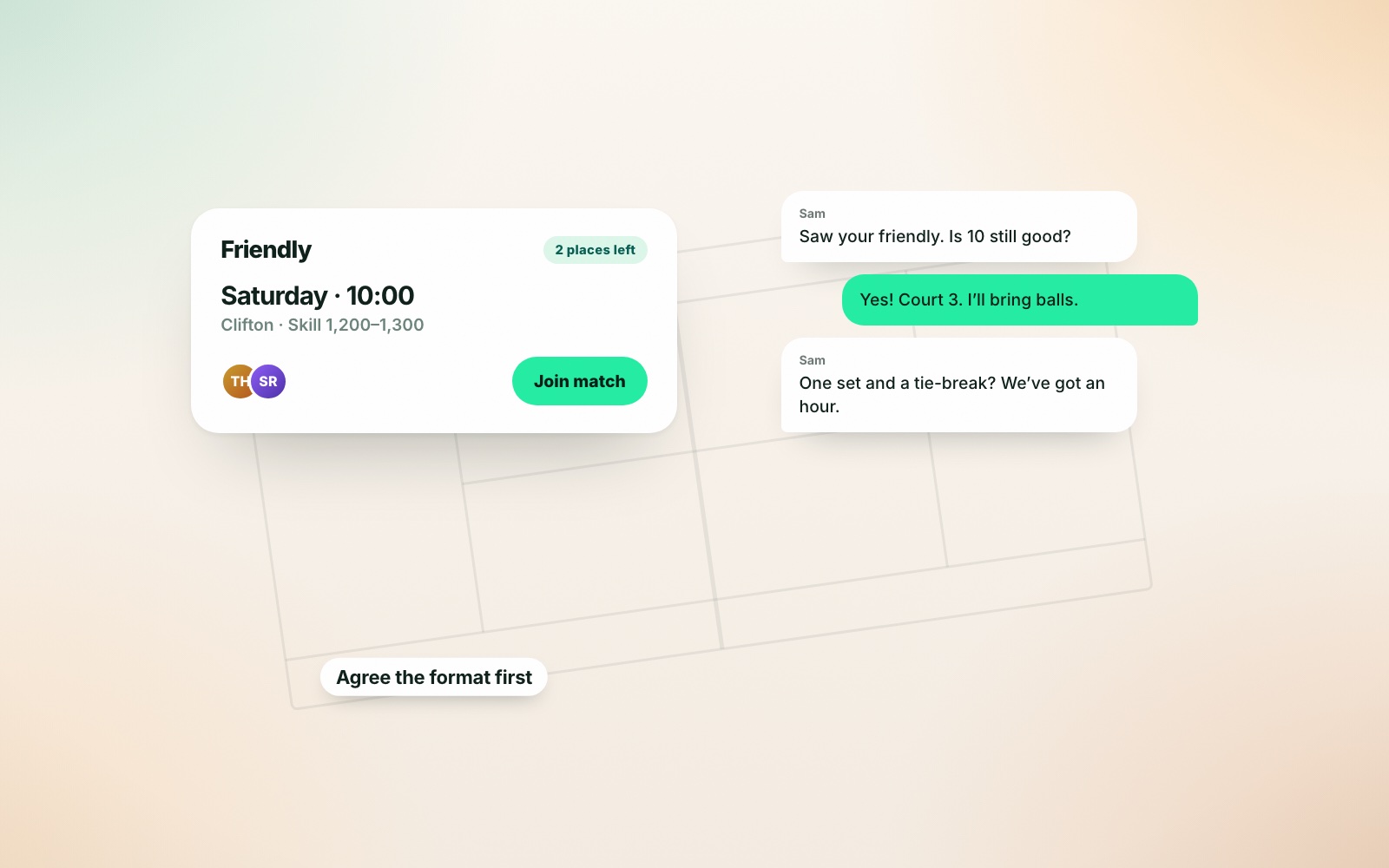
That is how it works on ContactFrame. The whole competition side of the app is called The Ladder. Your position comes from your Skill rating, which moves only on confirmed results, and you are ranked at your home court, your local area, your town or city, your region and the country at once. The everyday way to play is a friendly: you post a match with a skill range, a court and a time, and someone joins. There is more on that in how to arrange a friendly.
What it asks of you: nothing fixed. Play twice a week or twice a season.
The catch: with no deadline, it is easy to let a month go by. A ladder rewards people who are already self-starters.
What is a tennis league?
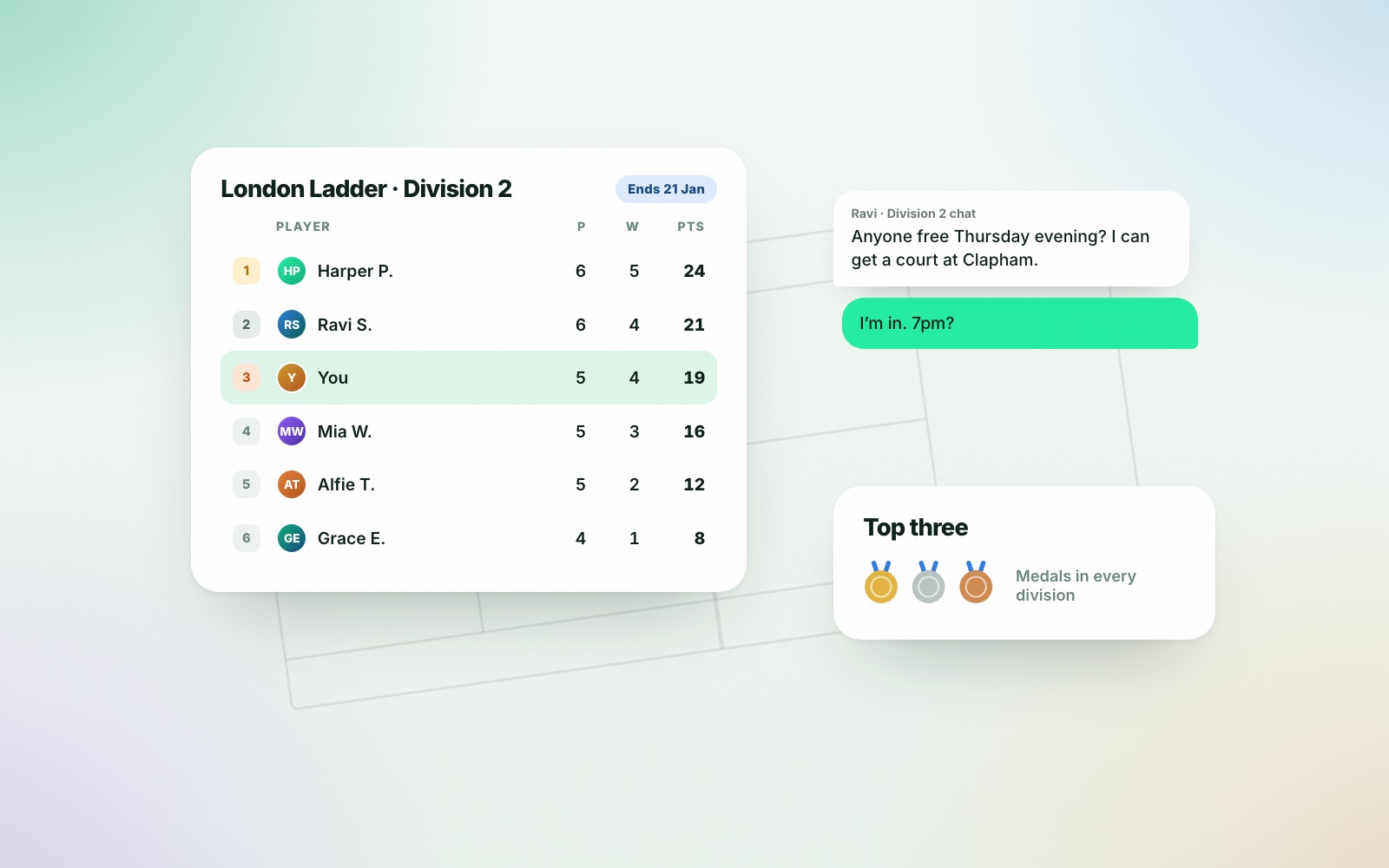
A league sorts players into divisions of similar standard. You play the others in your division within a set period, and the results build a table.
The structure is the appeal. You know who your opponents are from the first day and you know the date it all ends. Because the group is small and evenly matched, you get close matches against people you may well play again.
On ContactFrame you are placed in a division with players at your level, each division has its own table and group chat, and the top three in each division earn a medal. The detail is in how local tennis leagues work.
What it asks of you: several matches in a fixed window, and the organising that goes with them.
The catch: other people are relying on you. If you vanish for three weeks, you leave gaps in someone else’s table as well as your own.
What is a tennis tournament?
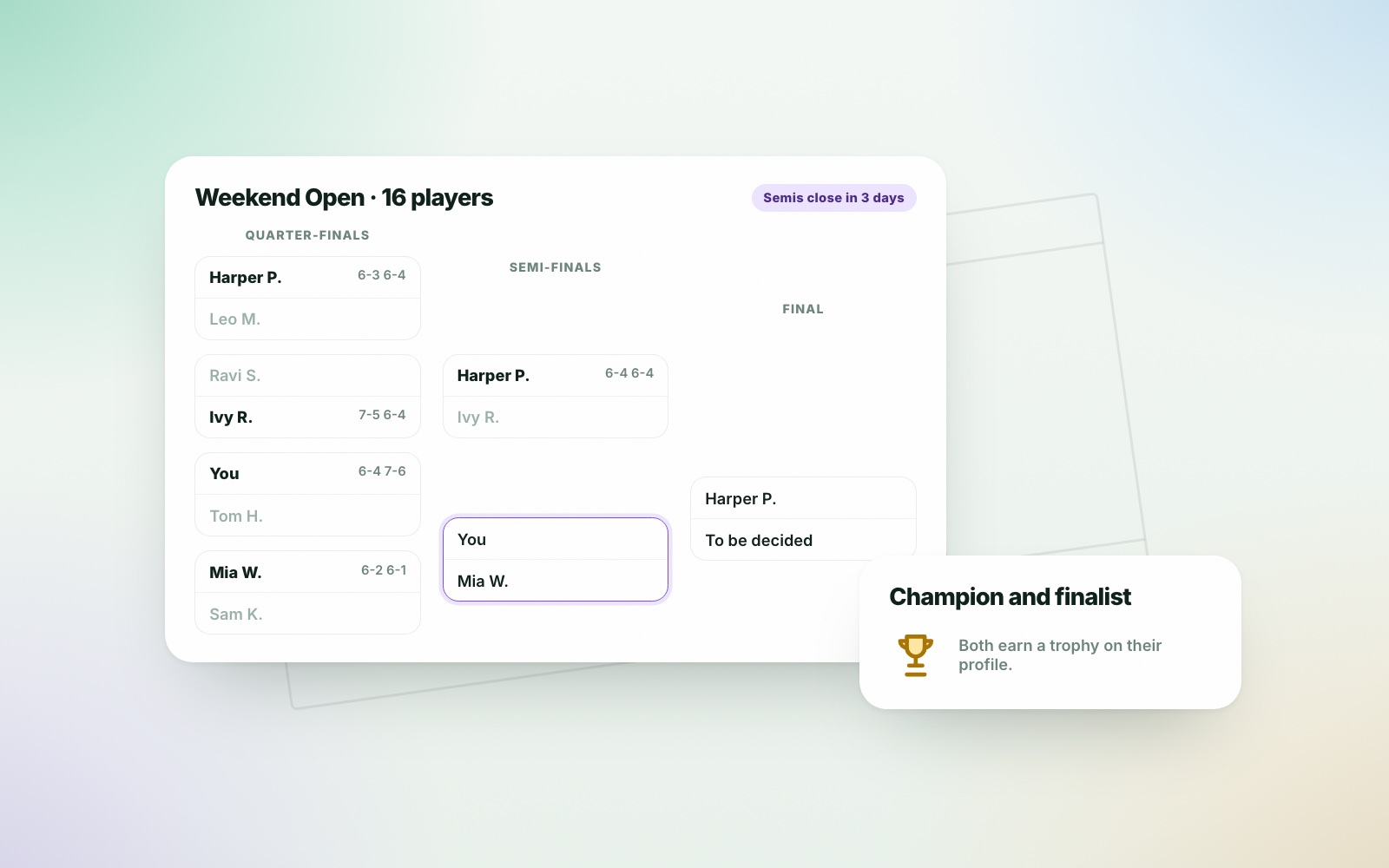
A tournament, in the sense most local players mean, is a knockout. Players are paired in a draw, winners advance and losers are out, until one player is left.
It is the most intense of the three. Every match is all or nothing, and the path to the final is visible from the first day. It is also the least generous with court time: half the entrants play once.
ContactFrame tournaments are seeded by Skill, the first round is drawn close to home, and every round has a deadline so the draw always finishes. The champion and finalist each earn a trophy. See tennis tournaments for adults for how draws and seeding work.
What it asks of you: one match per round, played before each deadline.
The catch: a bad day ends it. If you want guaranteed matches, look elsewhere.
Which tennis format suits which player?
You are new to competing
Start on the ladder with a couple of friendlies. One match, one opponent, no group depending on you. It gets the first-match nerves out of the way and starts to build a rating. If the whole idea is new, starting competitive tennis as an adult walks through the first steps.
You want to improve steadily
A league. Repeated close matches against the same standard are the best feedback you can get. You find out quickly whether last month’s practice shows up when it counts.
Your diary is chaotic
The ladder again. Shift workers, parents of small children and frequent travellers all do better with a format that has no deadline to miss.
You need a deadline to get anything done
A league or a tournament. If “we should play sometime” never turns into a match, a closing date will do what good intentions do not.
You like pressure
A tournament. Some players find their best tennis only when losing means going home. If that is you, a knockout is the format that will hold your interest.
You dislike pressure but want to get used to it
A league first, then a tournament. League matches matter, but one loss does not end your season. That is a kinder place to learn how to play a tight third set.
You mostly want to meet people to hit with
The ladder and its friendlies, plus a league for the group chat. For more ways to find partners, including those that involve no competition at all, see finding tennis partners near you.
You do not have to pick only one
These formats are not rivals. Many players keep the ladder ticking over all year, enter a league when they have a clear couple of months and add a tournament when they fancy one.
That works best when all three run on the same rating. On ContactFrame they do: a league match, a tournament match and a logged competitive friendly all feed the same Skill number and are confirmed the same way. Whatever you enter next, you are sorted using everything you have already played.
The cost differs slightly. Joining The Ladder, playing friendlies and appearing in the rankings are free. League and tournament entries each cost one credit.
A sensible first season
- Join the ladder and set a home court.
- Play a handful of friendlies against a range of opponents, and log every result.
- Once your rating has settled a little, enter a league.
- When the league ends, try a tournament and see how you handle the stakes.
By then you will know from experience which format you look forward to, and that is a better guide than any comparison. If you are still working out where you stand, finding your level in local tennis is the place to begin, and you can join the list for the app on the Ladder page.
Common questions
What is the difference between a tennis ladder and a league?
A ladder is a single ongoing ranking with no fixed schedule, and you move up or down as you play. A league puts you in a division with a set group of opponents and a start and end date, then produces a final table.
Is a tennis ladder or a league better for beginners?
A ladder is usually the gentler start, because you can play one match whenever it suits you and there is no group relying on you. A league is a good second step once you know you can commit to several matches in a set period.
How many matches do you play in a league compared with a tournament?
In a league you play several matches against the others in your division. In a knockout tournament you are guaranteed one match and play another each time you win.
Can I play in a ladder, a league and a tournament at the same time?
Yes, if your diary allows it. On ContactFrame they all use the same Skill rating and the same way of logging results, so matches in one format sit alongside the others.
Which tennis format is best if I have very little time?
An open ladder with friendlies. You arrange one match when you are free and there is no deadline to miss. A tournament can also work, since it may only ask for a match every round.
Pick a format. Or play all three.
One Skill rating covers friendlies, leagues and tournaments across the UK.
Explore the ladder