The short version
- A tennis rating exists to predict how close a match will be, so players can find even opponents.
- A rating is a number attached to you. A ranking is your place in a list. They are not the same.
- Self-rated levels are quick to set and slow to update, and people misjudge themselves in both directions.
- Results-based ratings correct themselves every time you play, but only if results are recorded honestly.
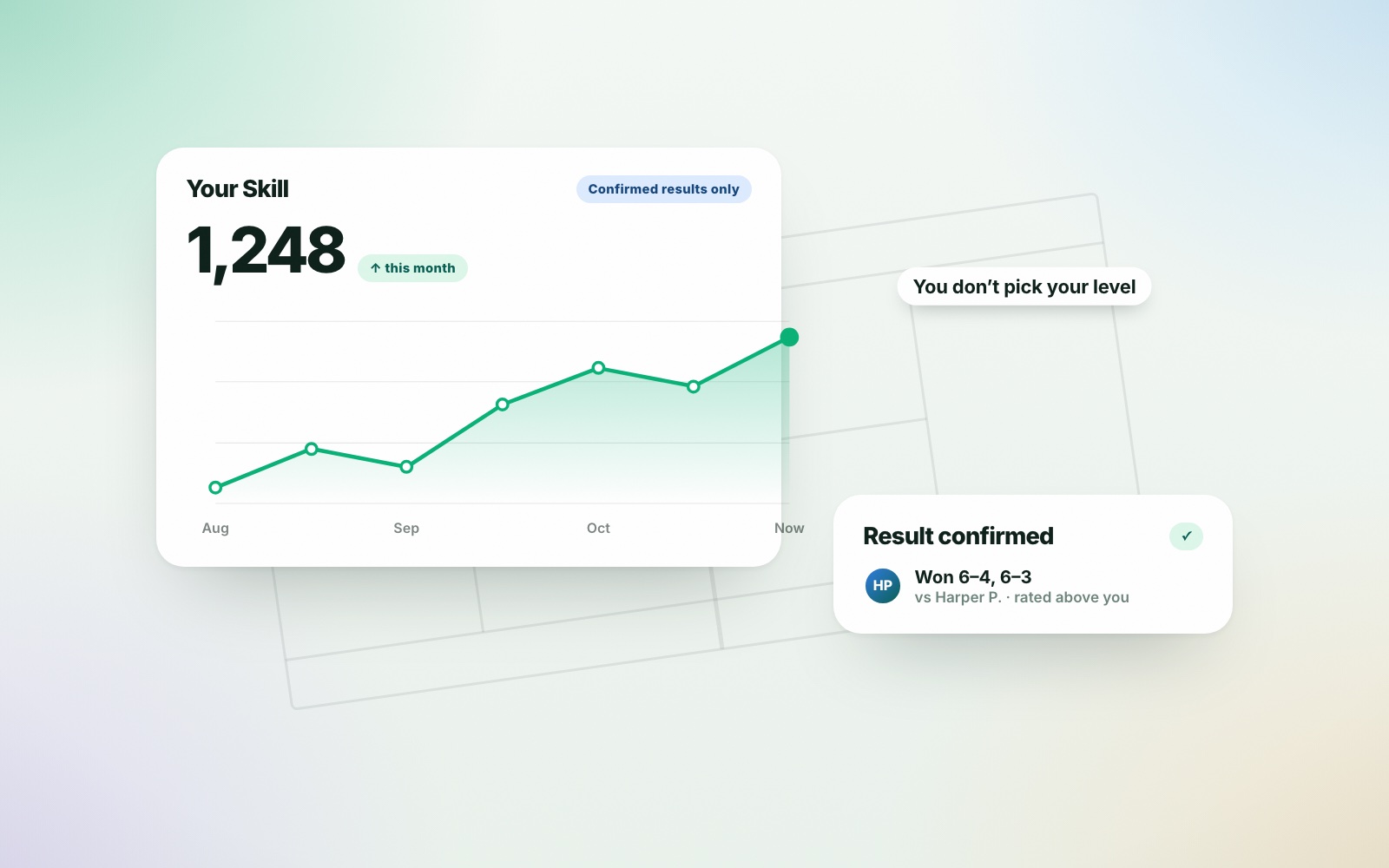
- ContactFrame’s Skill rating is results-based: you do not pick your level, and only confirmed results move it.
Someone asks what level you play at and you do not know what to say. “Intermediate” covers half of everyone who owns a racket. You have heard other players quote a number, sometimes with a decimal point, and you are not sure whether you are meant to have one. Most searches for tennis ratings explained come from exactly this moment.
This article is a general guide. It covers what a rating is for, the two broad ways of producing one and how to use a rating once you have it. It does not walk through the workings of any particular system.
What a tennis rating is for
Tennis is only fun within a fairly narrow band. Play someone much better and you spend an hour picking up balls. Play someone much weaker and neither of you gets a rally. The enjoyable matches, and the ones you learn from, are close.
A rating exists to find those matches. It compresses “how good is this person right now” into something two strangers can compare before they book a court. Everything else a rating is used for follows from that:
- Matching. Finding an opponent who will give you a real contest.
- Sorting. Putting league entrants into divisions and seeding a tournament draw.
- Tracking. Seeing whether you have improved relative to other players over a season.
A rating is not a measure of how good your strokes look, how long you have played or how much you know about tactics. It describes what tends to happen when you play a match.
Rating vs ranking
These two words get mixed up constantly.
A rating is a property of you. It would mean the same thing if you moved to another town.
A ranking is your position in a specific list. It depends on who else is in the list. You could be third at your local courts and well down the order in a big city with exactly the same rating.
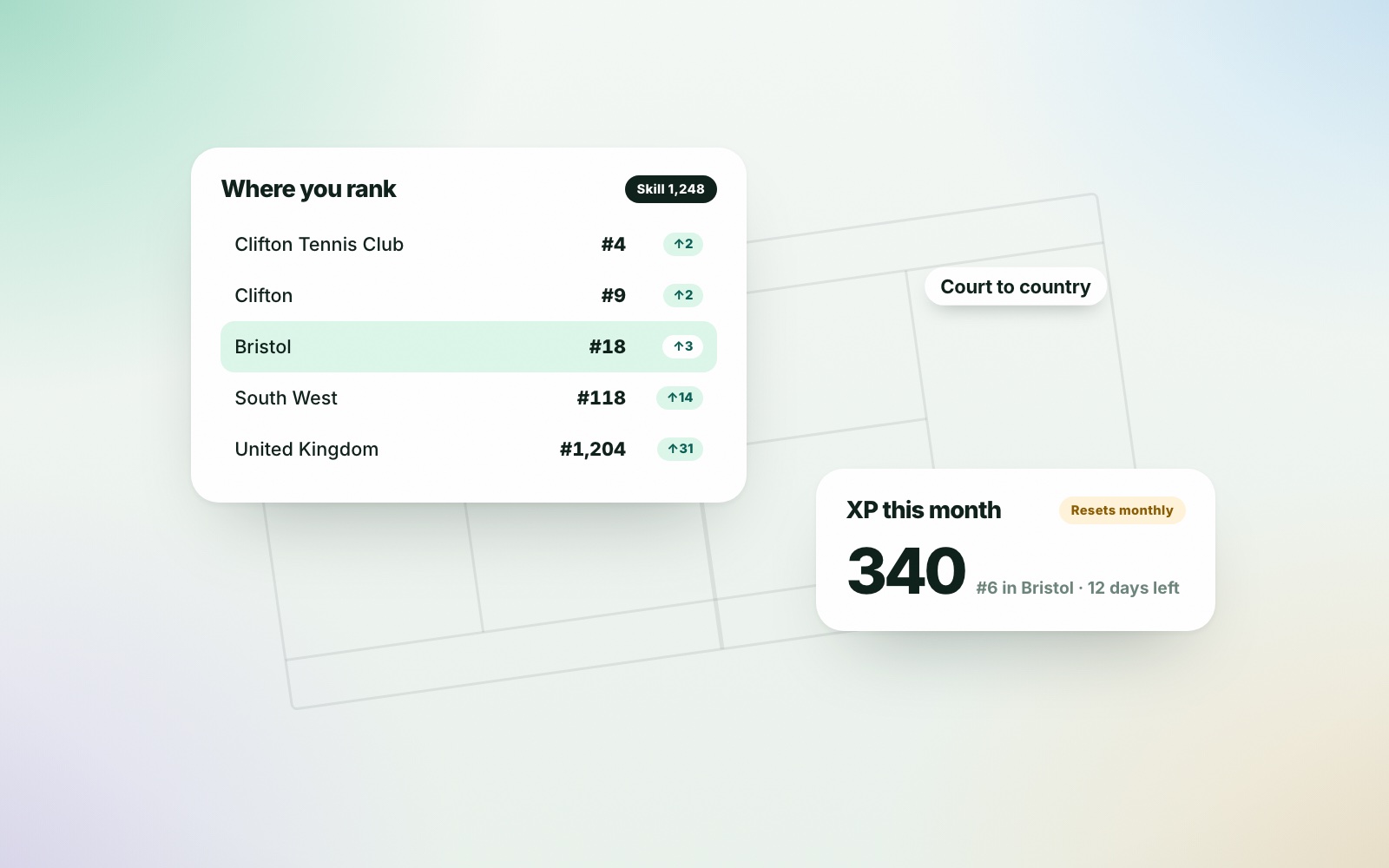
For finding a fair match, the rating is what matters. For bragging rights and motivation, the ranking does more. On ContactFrame one rating feeds rankings at several scales, which is covered in how rankings work from court to country.
Self-rated tennis levels
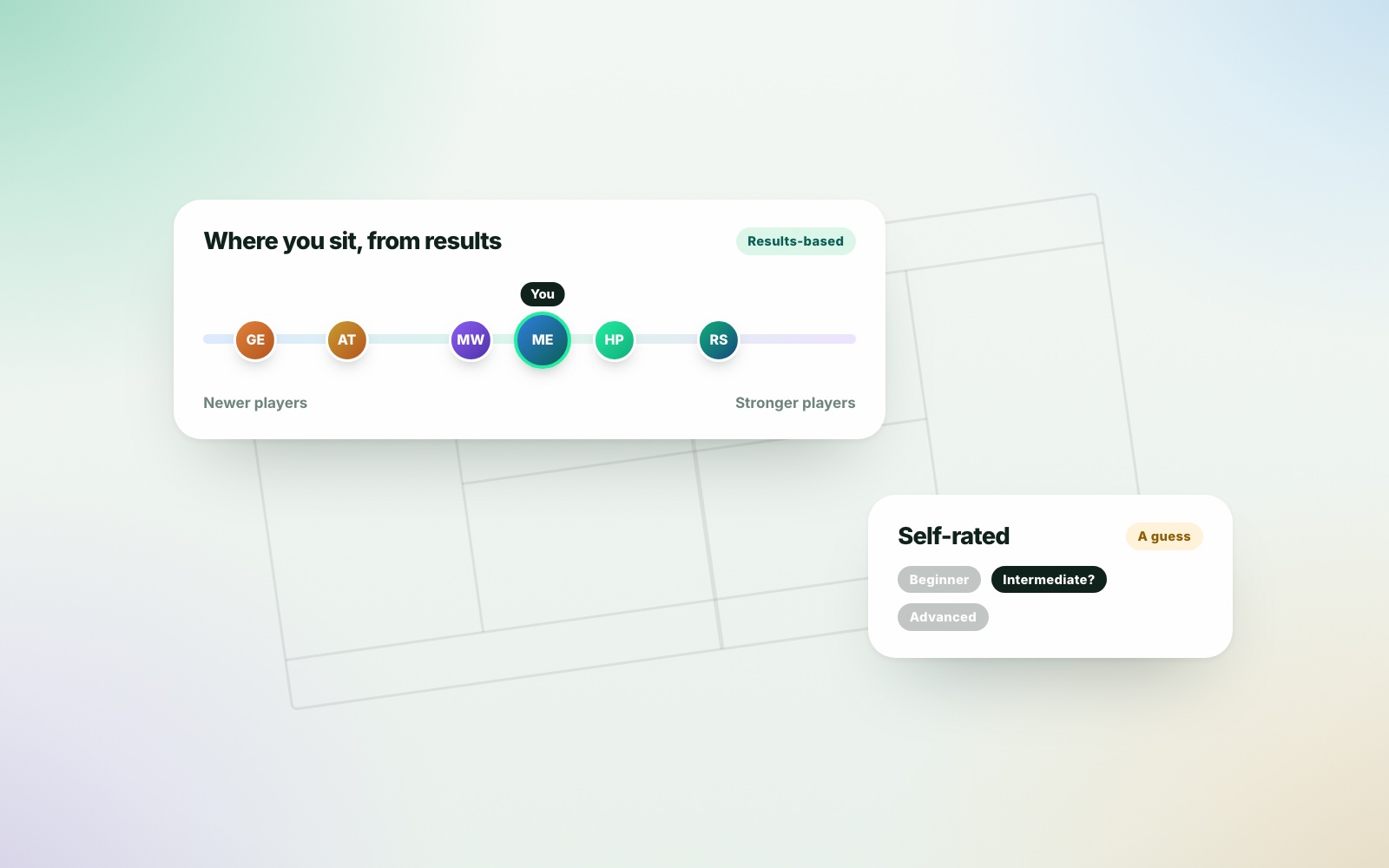
The oldest and simplest method is to ask. You read a set of descriptions, something like “can sustain a rally at moderate pace” or “has a reliable second serve”, and choose the one that sounds like you. Or you tick a box marked beginner, intermediate or advanced.
This has real advantages. It is instant. It needs no match history. It gives a brand new player somewhere to start.
It also has three well-known problems.
People are poor judges of themselves. Some rate their best day. Others, especially players returning after a long break, rate their worst. Two people reading the same description can land a long way apart.
Descriptions are about strokes, and matches are about results. A player with tidy technique who cannot hold serve under pressure will lose to a scrappy opponent who gets everything back. A description of the strokes does not capture that.
Labels go stale. You choose a level once. A year of lessons later, or a year off later, it still says the same thing. Nothing prompts you to change it.
None of this makes self-rating useless. As a first guess, it is fine. It only becomes a problem when a first guess is treated as a fact and used to sort a league.
Results-based tennis ratings
The other approach ignores what you say about yourself and looks at what happened on court. You play, the result is recorded and your rating responds.
The idea is the same wherever you meet it. A result you were expected to get changes little. A result nobody expected changes more. Over time the number settles at the point where your wins and losses make sense.
The strengths mirror the weaknesses of self-rating.
- It corrects itself. If you improve, you start winning matches you used to lose, and the rating follows.
- It measures what matters. It reflects match results, which is exactly what you want to predict.
- It is hard to flatter. You cannot talk your way to a higher number.
It has limits too, and it is fair to state them.
- It needs matches. With very few results, the number is a rough estimate. It becomes reliable as you play.
- It only knows its own results. A rating counts the matches recorded within that system and nothing else.
- It depends on honest results. If scores can be entered by one person without checking, the number can be gamed.
National and international rating systems exist, run by governing bodies and others, and many competitive players hold one. Each has its own rules about which matches count. If you play sanctioned events, that system’s own guidance is the place to learn how it treats you.
How ContactFrame’s Skill rating fits in
ContactFrame uses a results-based rating called Skill for The Ladder, its UK competition side.
You do not pick your own level. The rating is built from confirmed results: one player logs the result and the opponent confirms it, and a result nobody disputes is confirmed automatically after 24 hours. That two-person check is the answer to the honesty problem above.
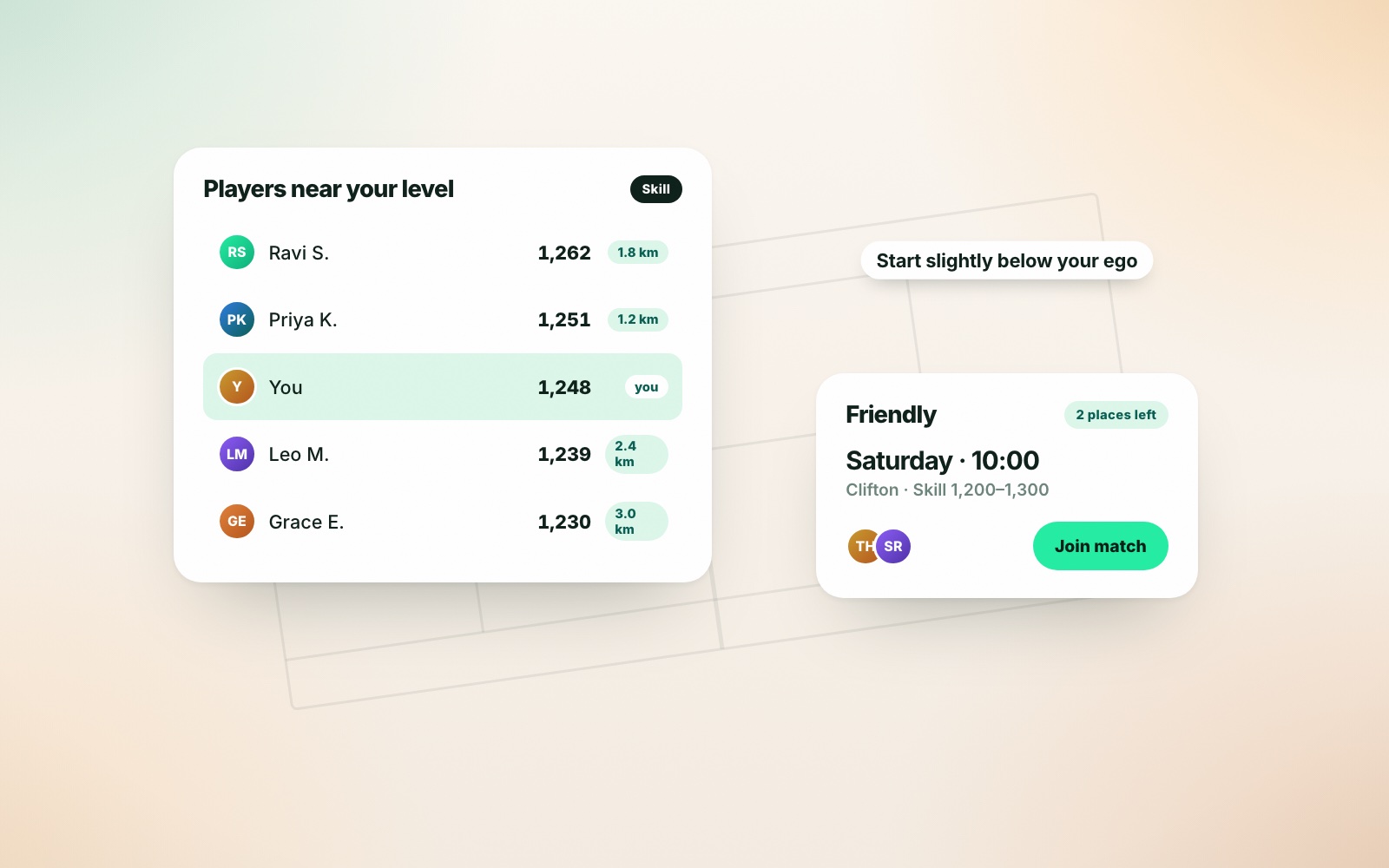
Skill is then put to work in the ways a rating should be. It places you in a league division with players at your level. It seeds tournament draws. It gives the skill range on a friendly something real to refer to. And it produces your rank at your home court and beyond.
It is ContactFrame’s own number. It does not replace or convert to any other rating you hold. For what moves it and what does not, see how the Skill rating works.
How to use a tennis rating well
Use it to find matches, not to define yourself. The number is a tool for locating good opponents. Look for people a little either side of you. Finding tennis partners near you has more on that.
Give it time. Early on, a rating moves around. That is the system working, not a verdict. Play a run of matches before you read anything into it.
Play up as well as down. Matches against slightly stronger players are where both your tennis and your rating have most to gain.
Do not protect it. Avoiding matches to keep a number safe defeats the purpose. A rating you are afraid to test is not telling you anything.
Pair it with something that explains it. A rating says whether you are winning. It cannot say why. For that you need to look at the tennis itself: which shots hold up and which break down. Measures such as shot quality from filmed sessions answer a different question from a rating, and the two work well together.
If you do not have a rating yet
You do not need one to start. Make an honest guess at your standard, arrange a few matches against a spread of opponents and see what happens. Our guide to finding your level in local tennis covers how to do that without it being awkward.
After a handful of results you will know far more than any description could have told you. Joining ContactFrame’s ladder is free, and you can get on the list for the app on the Ladder page.
Common questions
What is a tennis rating?
A tennis rating is a number or level that describes your current playing standard. Its purpose is to help players of similar ability find each other, and to let competitions sort entrants into fair groups.
What is the difference between a tennis rating and a ranking?
A rating is a measure of how well you play. A ranking is your position in an ordered list of players. Two players can hold the same rating, while a ranking places them one above the other.
Are self-rated tennis levels accurate?
They are a reasonable starting point and not much more. Players often rate themselves too high or too low, and a self-chosen label is rarely updated as their game changes.
How do I get a tennis rating in the UK?
You get a results-based rating by playing matches that are recorded in whichever system issues it. On ContactFrame you join the ladder, play, and your Skill rating forms from the results you and your opponents confirm.
Can I have more than one tennis rating?
Yes. National and international rating systems exist alongside club and app ratings, and each counts only the matches recorded within it. They can sit side by side without conflict.
Let your results set your level.
Join the UK ladder and get a Skill rating built from confirmed matches.
Explore the ladder