The short version
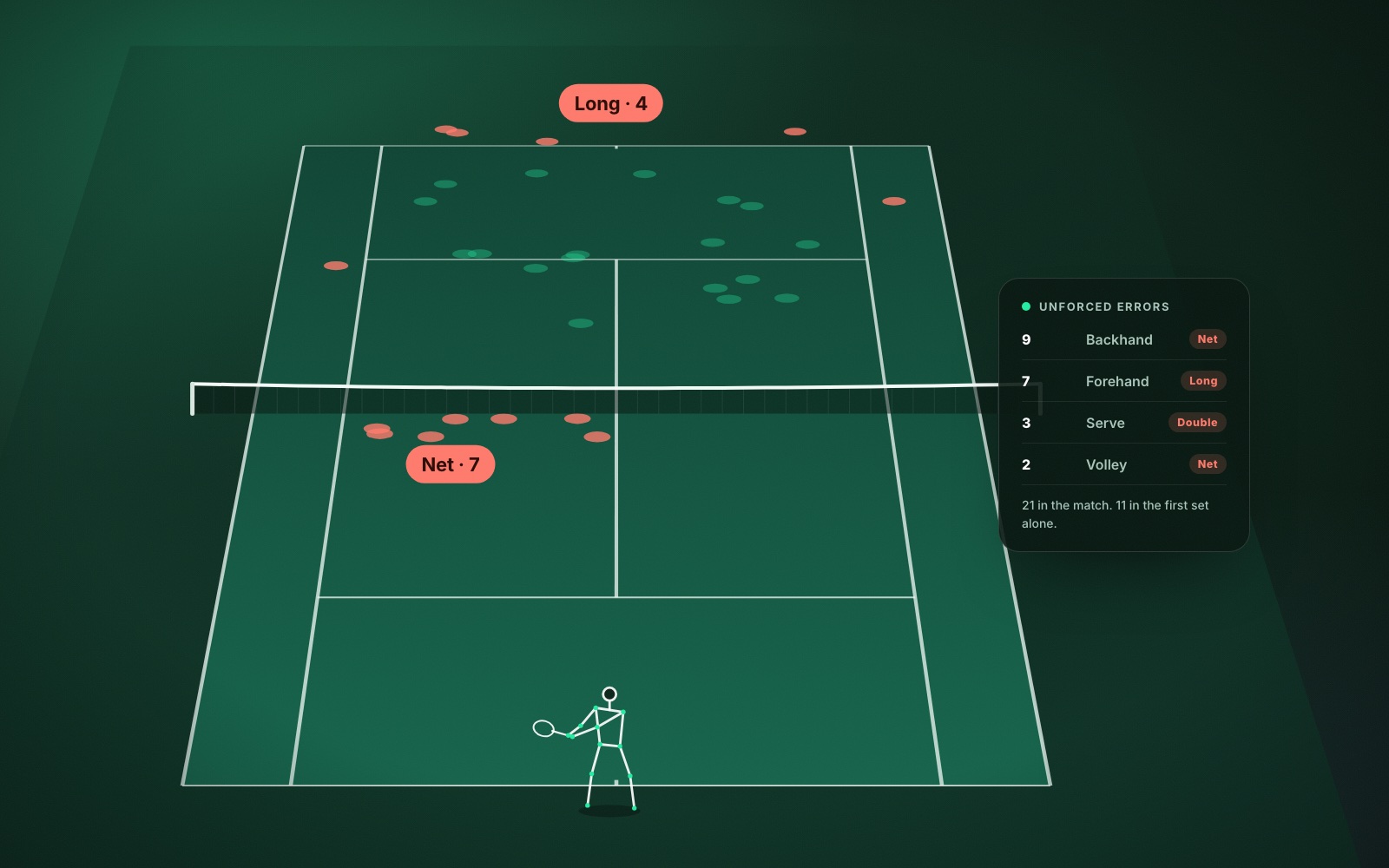
- At club level most points end in an error. Missing less is the quickest improvement available.
- Every point starts with a serve or a return. Give them a real share of your practice time.
- Depth beats pace. A deeper ball at the same speed gives your opponent a harder shot.
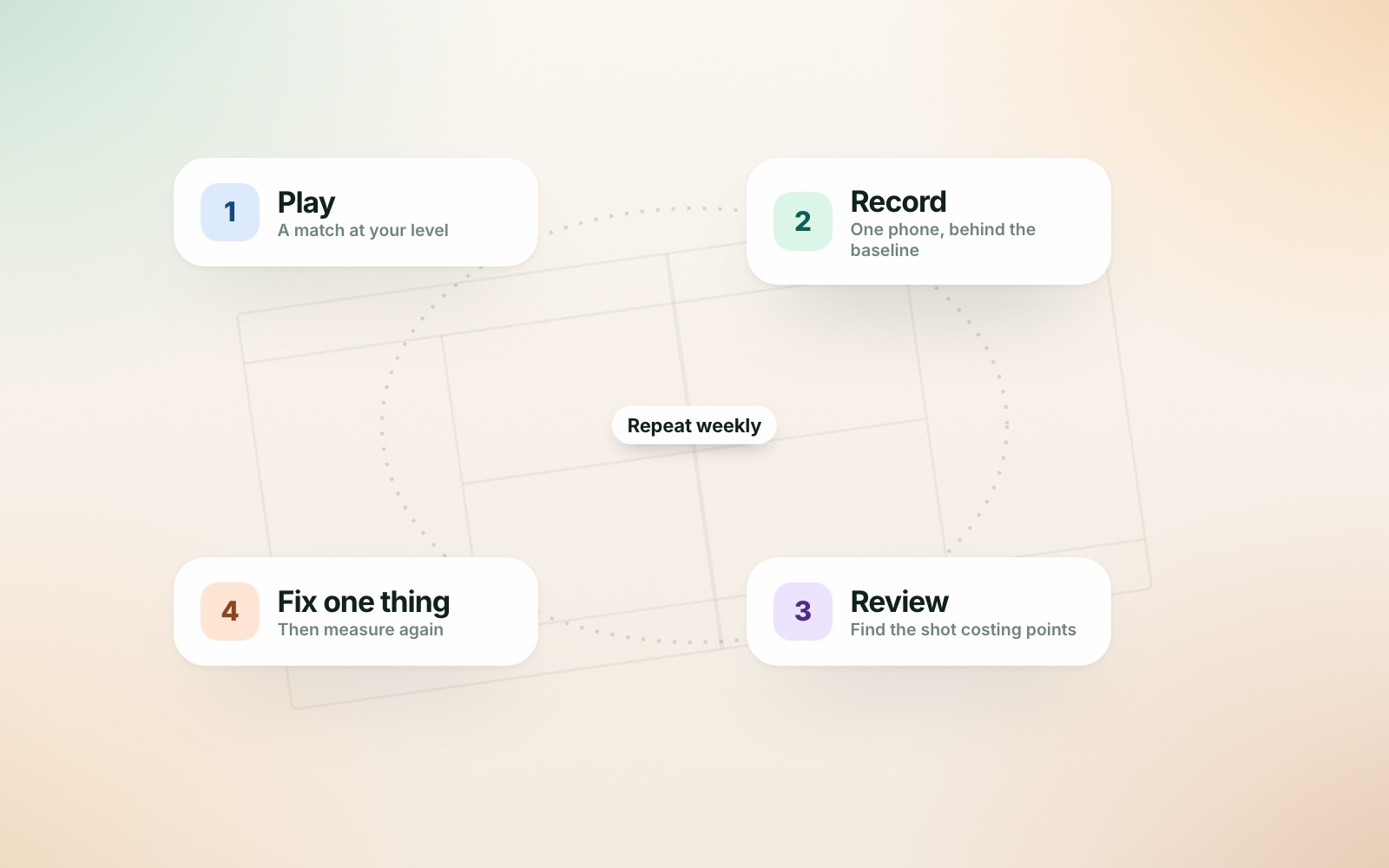
- Change one thing at a time and measure it, or you will not know what worked.
- “Fast” means weeks for consistency and months for technique. Anyone promising days is selling something.
You play every week and you are not getting better. Or you are, but so slowly that the people you lose to are still the people you lost to last year. If you are wondering how to get better at tennis without spending another season finding out what does not work, start by being honest about what “fast” can mean.
Nobody rebuilds a forehand in a fortnight. But most club players are not held back by their forehand. They are held back by a few fixable habits, and fixing those can change results in weeks. This is the plan, in order of how much each step is worth.
Why most club players stop improving
The usual week is an hour of friendly rallying down the middle, then a set. It is enjoyable and it practises almost nothing that decides a match. There is no serving under pressure, no returning, no hitting to a target and no record of whether anything changed.
Feel is a poor guide as well. A session where you hit three huge winners feels like progress, even if you also made thirty errors. Getting better quickly means practising the things that win points and checking the result with something firmer than memory.
Step one: stop giving away points
At club level, far more points end with an error than with a winner. That is true at nearly every standard below the professional game. It follows that the fastest way to win more is to miss less.
In practice this means:
- Aim crosscourt, where the net is lowest and the court is longest.
- Clear the net by a comfortable margin, not a few centimetres.
- Aim a couple of metres inside the lines, not at them.
- Swing at a pace you can repeat ten times in a row.
It is not glamorous and it works immediately. The detail is in how to cut unforced errors and how to improve your consistency.
Step two: fix the two shots that start every point
Every point begins with a serve and a return. Most adults practise neither.
A second serve you trust removes double faults, which are the purest form of free point. It also lets you swing more freely at the first. Spend fifteen minutes of every session serving, with at least half of it on second serves to a target. See how to improve your tennis serve and how to improve your second serve.
The return is simpler still. Your first aim is to get it back, deep and through the middle, so the server has to play another ball. How to improve your return of serve covers the adjustments.
Step three: hit deeper before you hit harder
Players chasing quick improvement usually reach for power. Depth pays better. A ball that lands near the baseline pushes your opponent back, gives them less angle and earns you shorter replies to attack. A hard ball that lands on the service line does none of that.
You can add depth without swinging faster: aim higher over the net and use a little more topspin to bring the ball down. Try how to hit deeper shots first. Power can come later, and when it does, how to add power to your shots explains how to add it without losing control.
Step four: move better between shots
A great many “bad shots” are bad positions. You were late, off balance, or still watching your last shot when the next one came back. Three habits fix most of it: a split step as your opponent hits, small adjusting steps before contact, and recovering towards the middle straight after you hit.
Footwork improves quickly because it is mostly attention, not talent. See how to improve tennis footwork and how to improve court coverage.
Step five: measure, so you know what changed
This is the step that makes the others faster. If you cannot tell whether a change worked, you will drop good changes and keep bad ones.
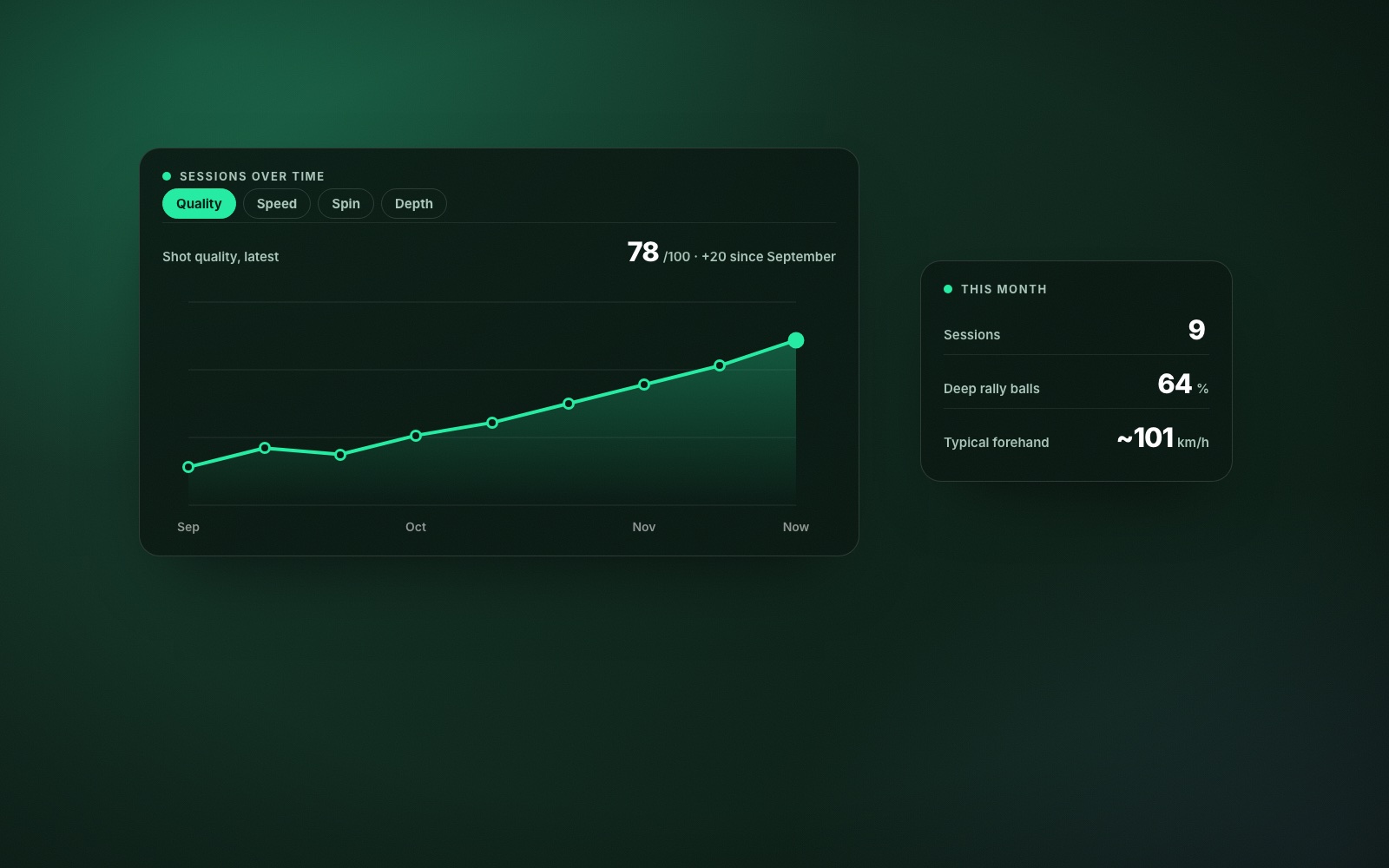
You can do this with a notebook: count first serves in out of twenty, your longest crosscourt rally, double faults per set. Or you can film. With ContactFrame, a phone on a tripod behind the baseline is enough. The Lab measures each shot’s speed, spin and where it bounced, and marks it in, out or close. Session insights break that down by shot type and show winners, forced errors and unforced errors.
Say your forehands average 95 km/h but only 60% land in. That tells you plainly that step one applies to your forehand. Three weeks later the same view shows whether it moved. ContactFrame’s session focus options, Depth, Consistency, Topspin, Power and Placement, match the themes in this plan, and Trends show the same measures session after session.
Step six: one fix at a time
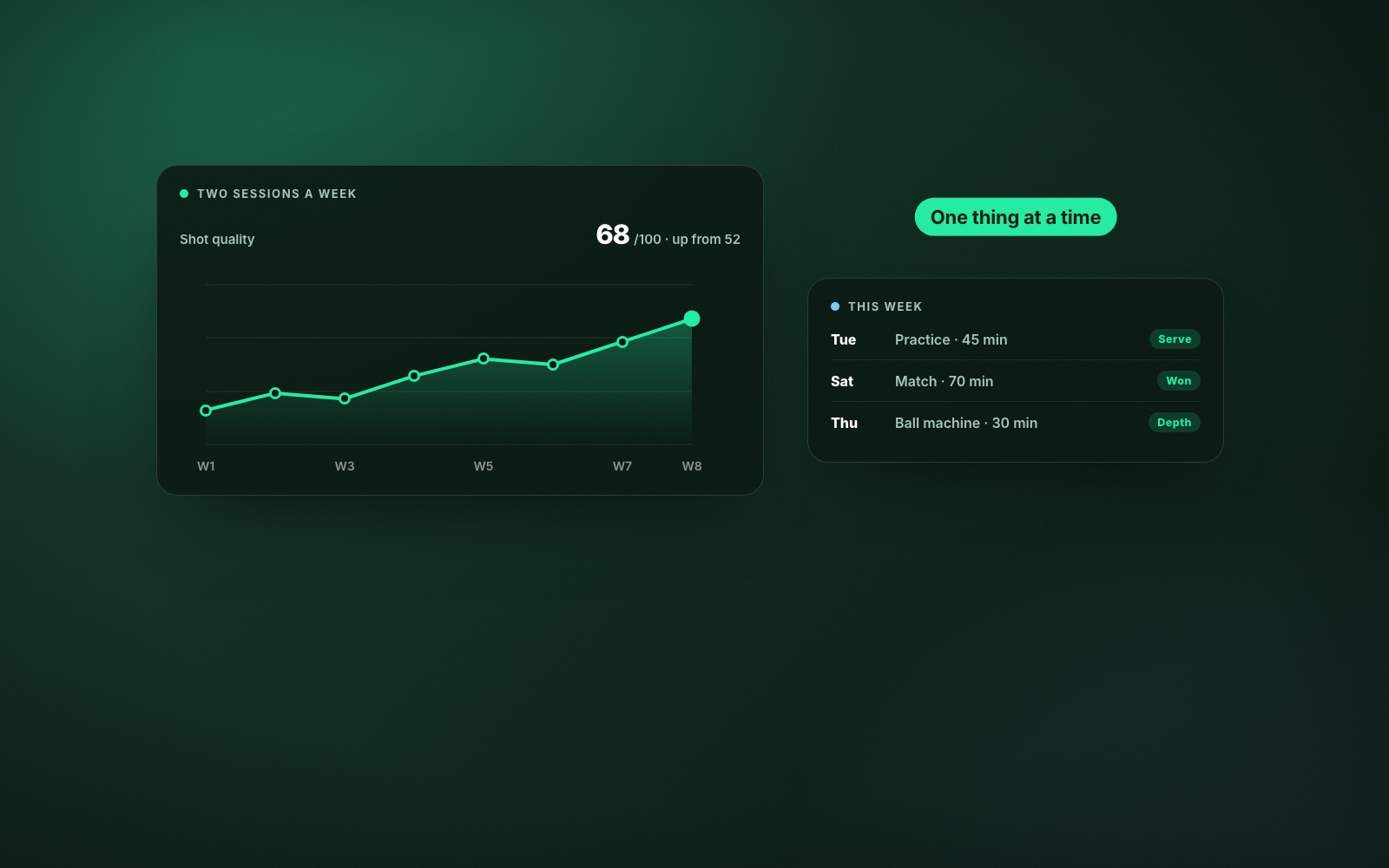
Trying to change your grip, your footwork and your serve in the same week changes none of them. Pick one thing. Give it three or four weeks. Then move on.
If you are on the Pro plan, shot mechanics gives you a single Next fix and a drill for it, which is the same principle built in. Without it, choose the weakest number from your last session and make that the month’s theme.
Expect things to get slightly worse before they get better. A changed stroke feels wrong for a while, and that is normal.
Step seven: play matches that count
Practice makes shots. Matches make a player. You learn to serve at 4–5, to recover from a bad game and to beat someone whose style you dislike only by doing it.
Play someone slightly better as often as you can find them. Joining a ladder or a local league, such as the UK ladder in ContactFrame, gives you a steady supply of opponents at your level and a result to learn from each time. Then use what happened to choose the next practice theme. How to win more tennis points shows how to read a match that way.
A weekly plan to get better at tennis
For a player with three sessions a week:
- Session one, practice. Fifteen minutes of serves and returns, then crosscourt rallies to a depth target, then one drill for this month’s fix.
- Session two, match play. A set or a league match. Note what cost you points.
- Session three, solo or short. A basket of serves, a wall, or a ball machine. See how to practise tennis alone.
With two sessions, keep the first two. With one, split it: half practice, half points.
How fast is fast?
Consistency and shot selection can improve within two or three weeks, because they are decisions. Serve reliability usually takes a month or two of regular practice. A real technical change takes a few months to feel natural, and longer to survive a tight match. These are rough guides and people vary.
That may be slower than the title promised. It is still far quicker than another year of rallying down the middle and hoping. Tracking your progress is what keeps you going through the weeks when it does not feel like it is working.
Common questions
How can I get better at tennis quickly?
Cut your unforced errors, make your serve and return reliable, and practise with a specific aim each session. Then play matches to test it. Those four habits improve results faster than working on any single stroke.
How long does it take to get good at tennis?
It depends on where you start and how often you play. With two or three purposeful sessions a week, most adults notice steadier rallies within a few weeks and a clear change in their match results over a few months. Technical changes take longer to hold under pressure.
How many times a week should I play tennis to improve?
Two or three sessions a week is a realistic target for most adults: one for practice, one for match play, and a third for serves or drills if you can. Regular short sessions beat one long session a fortnight.
Can I improve at tennis without a coach?
Yes, up to a point. Purposeful practice, match play and video of your own sessions will take you a long way. A coach is still the best way to fix a technical problem you cannot see or feel yourself.
What should a beginner work on first?
Getting the ball in play. A serve that starts the point, a return that comes back, and rallies of five or six balls down the middle. Power and placement can wait until those are dependable.
Measure it. Then improve it.
Join the list for ContactFrame and see what each session really looked like, shot by shot.
See The Lab